Question 3
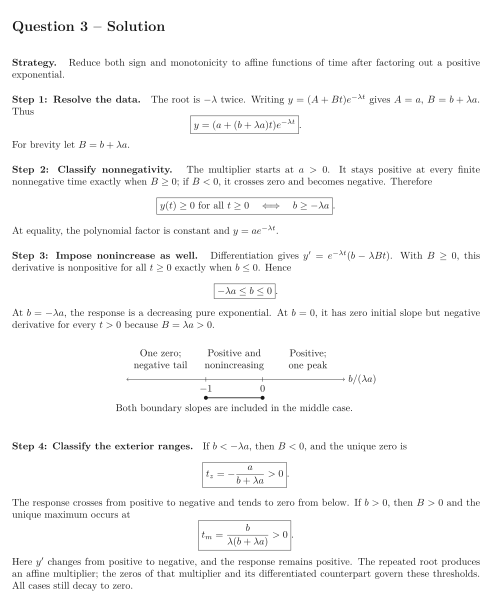
For and , consider Classify all real slopes on .
Tasks
Find the solution in terms of .
Prove exactly when the response remains nonnegative for every .
Prove exactly when it is both nonnegative and nonincreasing, treating the boundary slopes separately.
For the remaining slopes, find the unique zero or positive-time maximum, as appropriate. Summarize the cases on a diagram of and explain how the repeated root enters the classification.
Show solutionHide solution
Question 3 – Solution
Strategy. Reduce both sign and monotonicity to affine functions of time after factoring out a positive exponential.
Step 1: Resolve the data. The root is twice. Writing gives , . Thus For brevity let .
Step 2: Classify nonnegativity. The multiplier starts at . It stays positive at every finite nonnegative time exactly when ; if , it crosses zero and becomes negative. Therefore At equality, the polynomial factor is constant and .
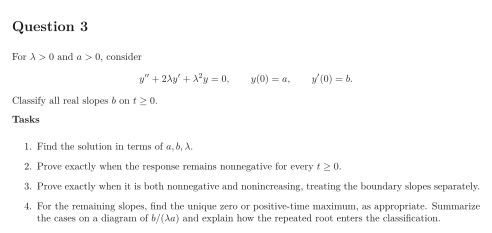
Step 3: Impose nonincrease as well. Differentiation gives . With , this derivative is nonpositive for all exactly when . Hence At , the response is a decreasing pure exponential. At , it has zero initial slope but negative derivative for every because .
See the diagram in the original worksheet below.
Step 4: Classify the exterior ranges. If , then , and the unique zero is The response crosses from positive to negative and tends to zero from below. If , then and the unique maximum occurs at Here changes from positive to negative, and the response remains positive. The repeated root produces an affine multiplier; the zeros of that multiplier and its differentiated counterpart govern these thresholds. All cases still decay to zero.