Question 5
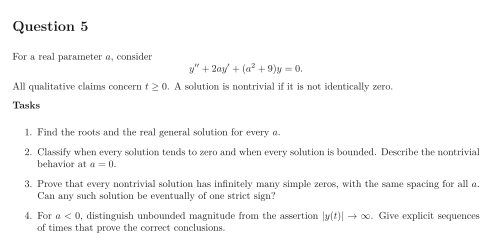
For a real parameter , consider All qualitative claims concern . A solution is nontrivial if it is not identically zero.
Tasks
Find the roots and the real general solution for every .
Classify when every solution tends to zero and when every solution is bounded. Describe the nontrivial behavior at .
Prove that every nontrivial solution has infinitely many simple zeros, with the same spacing for all . Can any such solution be eventually of one strict sign?
For , distinguish unbounded magnitude from the assertion . Give explicit sequences of times that prove the correct conclusions.
Show solutionHide solution
Question 5 – Solution
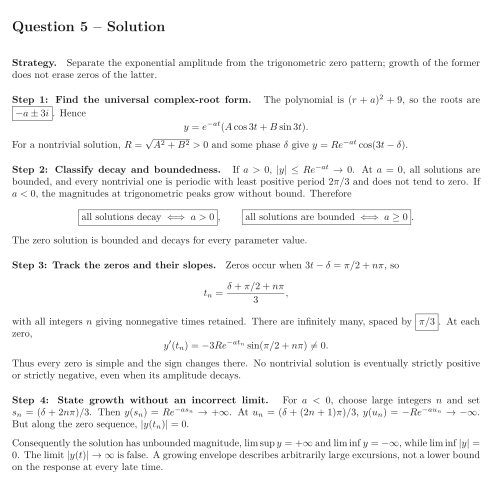
Strategy. Separate the exponential amplitude from the trigonometric zero pattern; growth of the former does not erase zeros of the latter.
Step 1: Find the universal complex-root form. The polynomial is , so the roots are . Hence For a nontrivial solution, and some phase give .
Step 2: Classify decay and boundedness. If , . At , all solutions are bounded, and every nontrivial one is periodic with least positive period and does not tend to zero. If , the magnitudes at trigonometric peaks grow without bound. Therefore The zero solution is bounded and decays for every parameter value.
Step 3: Track the zeros and their slopes. Zeros occur when , so with all integers giving nonnegative times retained. There are infinitely many, spaced by . At each zero, Thus every zero is simple and the sign changes there. No nontrivial solution is eventually strictly positive or strictly negative, even when its amplitude decays.
Step 4: State growth without an incorrect limit. For , choose large integers and set . Then . At , . But along the zero sequence, .
Consequently the solution has unbounded magnitude, and , while . The limit is false. A growing envelope describes arbitrarily large excursions, not a lower bound on the response at every late time.