Question 7
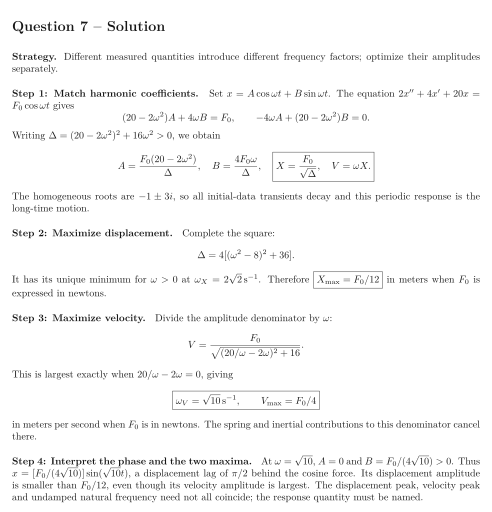
A mass–spring–damper system has , and . Forcing is , where is fixed and . Consider its steady periodic response. Let be displacement amplitude and be velocity amplitude.
Tasks
Derive the cosine and sine coefficients of the steady response and express and in terms of .
Find the frequency that maximizes displacement amplitude and its maximum value.
Independently find the frequency that maximizes velocity amplitude and its maximum value.
At the velocity-maximizing frequency, determine the displacement phase relative to the applied force. Explain why a request for the ’resonant frequency’ needs a specified response quantity.
Show solutionHide solution
Question 7 – Solution
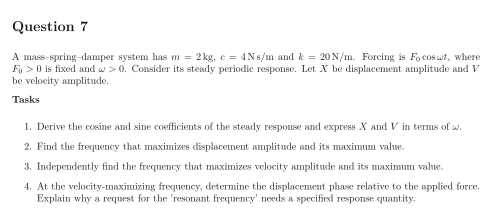
Strategy. Different measured quantities introduce different frequency factors; optimize their amplitudes separately.
Step 1: Match harmonic coefficients. Set . The equation gives Writing , we obtain The homogeneous roots are , so all initial-data transients decay and this periodic response is the long-time motion.
Step 2: Maximize displacement. Complete the square: It has its unique minimum for at . Therefore in meters when is expressed in newtons.
Step 3: Maximize velocity. Divide the amplitude denominator by : This is largest exactly when , giving in meters per second when is in newtons. The spring and inertial contributions to this denominator cancel there.
Step 4: Interpret the phase and the two maxima. At , and . Thus , a displacement lag of behind the cosine force. Its displacement amplitude is smaller than , even though its velocity amplitude is largest. The displacement peak, velocity peak and undamped natural frequency need not all coincide; the response quantity must be named.