Question 5
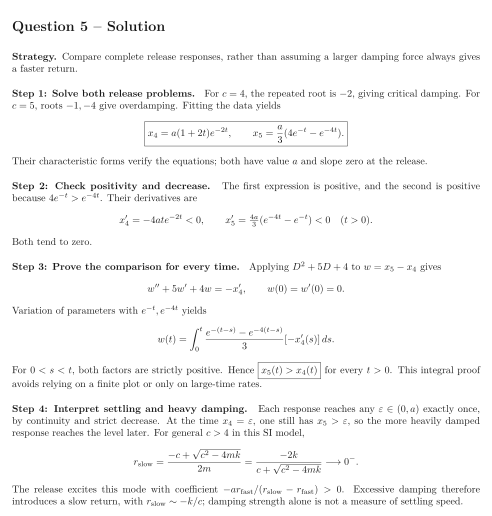
A mass on a spring with is released from , with . Compare viscous damping coefficients and ; write their responses as .
Tasks
Determine the damping regimes and find both exact responses.
Prove that each response stays positive and strictly decreases for .
Prove for every . You may form the equation for and derive its zero-data integral response.
Explain the implication for the first time the displacement reaches any fixed level with . For general , examine the slow characteristic root as .
Show solutionHide solution
Question 5 – Solution
Strategy. Compare complete release responses, rather than assuming a larger damping force always gives a faster return.
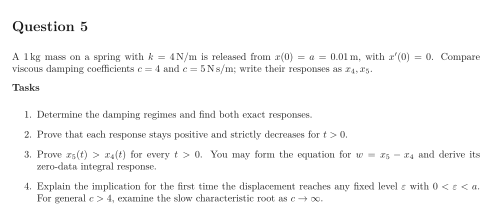
Step 1: Solve both release problems. For , the repeated root is , giving critical damping. For , roots give overdamping. Fitting the data yields Their characteristic forms verify the equations; both have value and slope zero at the release.
Step 2: Check positivity and decrease. The first expression is positive, and the second is positive because . Their derivatives are Both tend to zero.
Step 3: Prove the comparison for every time. Applying to gives Variation of parameters with yields For , both factors are strictly positive. Hence for every . This integral proof avoids relying on a finite plot or only on large-time rates.
Step 4: Interpret settling and heavy damping. Each response reaches any exactly once, by continuity and strict decrease. At the time , one still has , so the more heavily damped response reaches the level later. For general in this SI model, The release excites this mode with coefficient . Excessive damping therefore introduces a slow return, with ; damping strength alone is not a measure of settling speed.