Question 3
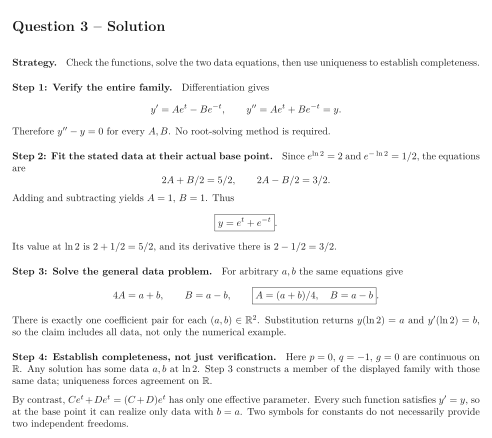
The functions and are supplied as candidate solutions of You may use this theorem: if are continuous on an open interval , then with , , , has exactly one solution on .
Tasks
Verify that every solves the equation, without using a characteristic equation.
Determine when and . Verify both data.
For arbitrary real data , , solve for . Show that every pair of initial data can be realized.
Use the theorem to prove that the displayed family contains every solution on . Explain why having two named constants would not be sufficient if the proposed family were instead.
Show solutionHide solution
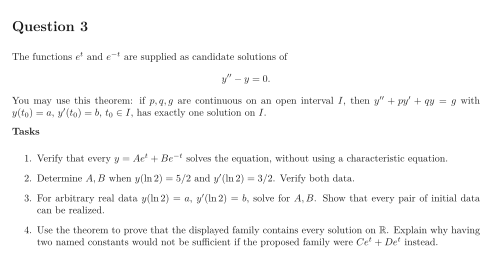
Question 3 – Solution
Strategy. Check the functions, solve the two data equations, then use uniqueness to establish completeness.
Step 1: Verify the entire family. Differentiation gives Therefore for every . No root-solving method is required.
Step 2: Fit the stated data at their actual base point. Since and , the equations are Adding and subtracting yields , . Thus Its value at is , and its derivative there is .
Step 3: Solve the general data problem. For arbitrary the same equations give There is exactly one coefficient pair for each . Substitution returns and , so the claim includes all data, not only the numerical example.
Step 4: Establish completeness, not just verification. Here , , are continuous on . Any solution has some data at . Step 3 constructs a member of the displayed family with those same data; uniqueness forces agreement on .
By contrast, has only one effective parameter. Every such function satisfies , so at the base point it can realize only data with . Two symbols for constants do not necessarily provide two independent freedoms.