Question 1
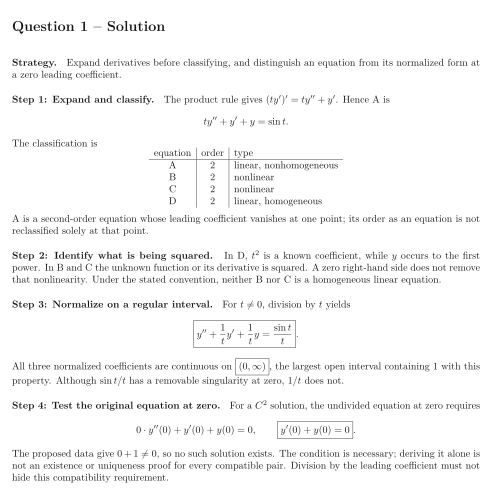
Consider the following differential equations for a real function : An equation is linear in if and its derivatives occur to the first power, are not multiplied together, and have coefficients depending only on . The terms homogeneous and nonhomogeneous here refer to linear equations with zero and nonzero forcing, respectively.
Tasks
Expand equation A. Classify all four equations by order and linearity; classify the linear ones by homogeneity.
Explain why does not destroy linearity, whereas and do. Does a zero right-hand side make B or C a homogeneous linear equation?
Put A in the form . Find the largest open interval containing on which these coefficients are continuous.
Suppose a solution of the undivided equation A passes through . Derive the necessary relation between and . Can , be prescribed there?
Show solutionHide solution
Question 1 – Solution
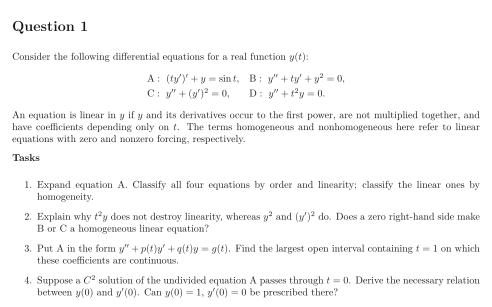
Strategy. Expand derivatives before classifying, and distinguish an equation from its normalized form at a zero leading coefficient.
Step 1: Expand and classify. The product rule gives . Hence A is The classification is A is a second-order equation whose leading coefficient vanishes at one point; its order as an equation is not reclassified solely at that point.
Step 2: Identify what is being squared. In D, is a known coefficient, while occurs to the first power. In B and C the unknown function or its derivative is squared. A zero right-hand side does not remove that nonlinearity. Under the stated convention, neither B nor C is a homogeneous linear equation.
Step 3: Normalize on a regular interval. For , division by yields All three normalized coefficients are continuous on , the largest open interval containing 1 with this property. Although has a removable singularity at zero, does not.
Step 4: Test the original equation at zero. For a solution, the undivided equation at zero requires The proposed data give , so no such solution exists. The condition is necessary; deriving it alone is not an existence or uniqueness proof for every compatible pair. Division by the leading coefficient must not hide this compatibility requirement.