Question 5
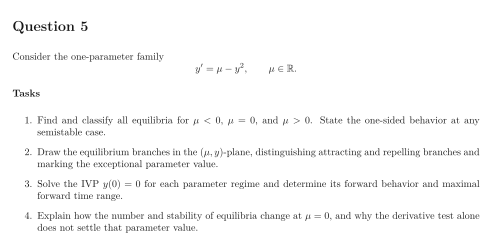
Consider the one-parameter family
Tasks
Find and classify all equilibria for , , and . State the one-sided behavior at any semistable case.
Draw the equilibrium branches in the -plane, distinguishing attracting and repelling branches and marking the exceptional parameter value.
Solve the IVP for each parameter regime and determine its forward behavior and maximal forward time range.
Explain how the number and stability of equilibria change at , and why the derivative test alone does not settle that parameter value.
Show solutionHide solution
Question 5 – Solution
Strategy. Compare a horizontal parameter with , and treat the double zero separately from the two simple roots.
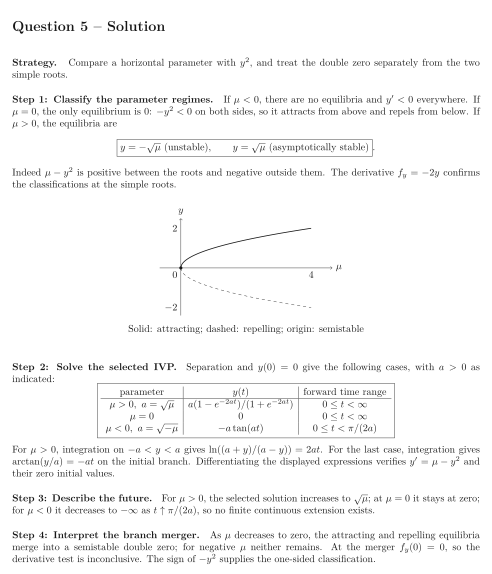
Step 1: Classify the parameter regimes. If , there are no equilibria and everywhere. If , the only equilibrium is : on both sides, so it attracts from above and repels from below. If , the equilibria are Indeed is positive between the roots and negative outside them. The derivative confirms the classifications at the simple roots.
See the diagram in the original worksheet below.
Step 2: Solve the selected IVP. Separation and give the following cases, with as indicated: For , integration on gives . For the last case, integration gives on the initial branch. Differentiating the displayed expressions verifies and their zero initial values.
Step 3: Describe the future. For , the selected solution increases to ; at it stays at zero; for it decreases to as , so no finite continuous extension exists.
Step 4: Interpret the branch merger. As decreases to zero, the attracting and repelling equilibria merge into a semistable double zero; for negative neither remains. At the merger , so the derivative test is inconclusive. The sign of supplies the one-sided classification.