Question 8
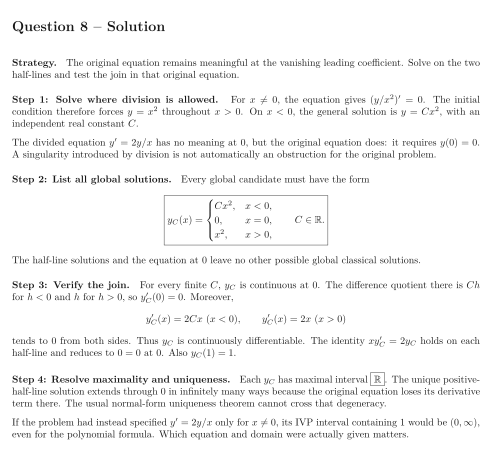
Consider the equation in its original, undivided form: It is defined for all real , including . A classical solution must be continuously differentiable and satisfy this equation at every point of its open interval.
Tasks
Solve on and explain why dividing by cannot by itself settle continuation through for the original equation.
Find every global classical solution of the original IVP.
Check both the differential equation and continuous differentiability at for your full family.
Determine the maximal interval of each such solution. Explain how uniqueness on can coexist with nonunique global continuation, and why this differs from an equation explicitly defined only for .
Show solutionHide solution
Question 8 – Solution
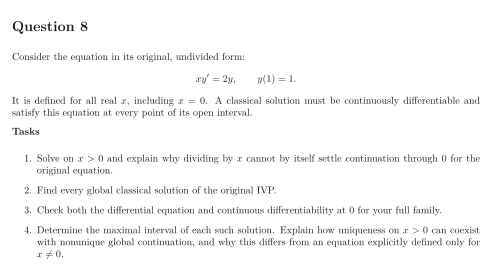
Strategy. The original equation remains meaningful at the vanishing leading coefficient. Solve on the two half-lines and test the join in that original equation.
Step 1: Solve where division is allowed. For , the equation gives . The initial condition therefore forces throughout . On , the general solution is , with an independent real constant .
The divided equation has no meaning at , but the original equation does: it requires . A singularity introduced by division is not automatically an obstruction for the original problem.
Step 2: List all global solutions. Every global candidate must have the form The half-line solutions and the equation at leave no other possible global classical solutions.
Step 3: Verify the join. For every finite , is continuous at . The difference quotient there is for and for , so . Moreover, tends to from both sides. Thus is continuously differentiable. The identity holds on each half-line and reduces to at . Also .
Step 4: Resolve maximality and uniqueness. Each has maximal interval . The unique positive-half-line solution extends through in infinitely many ways because the original equation loses its derivative term there. The usual normal-form uniqueness theorem cannot cross that degeneracy.
If the problem had instead specified only for , its IVP interval containing would be , even for the polynomial formula. Which equation and domain were actually given matters.