Question 6
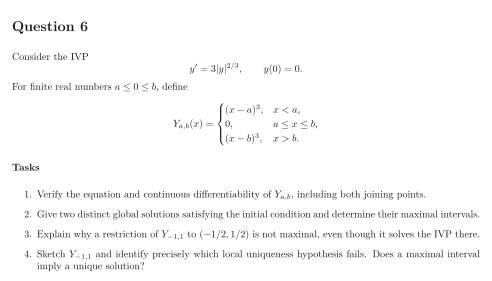
Consider the IVP For finite real numbers , define
Tasks
Verify the equation and continuous differentiability of , including both joining points.
Give two distinct global solutions satisfying the initial condition and determine their maximal intervals.
Explain why a restriction of to is not maximal, even though it solves the IVP there.
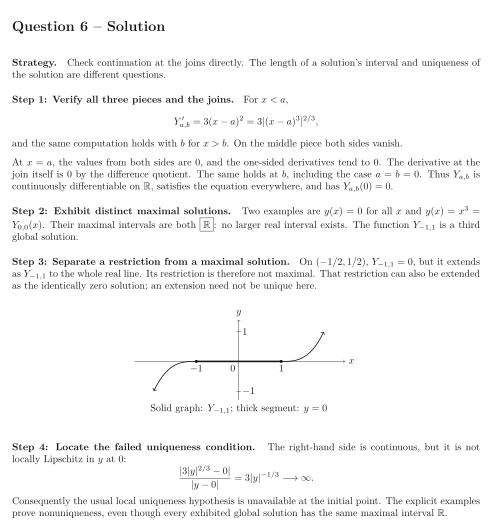
Sketch and identify precisely which local uniqueness hypothesis fails. Does a maximal interval imply a unique solution?
Show solutionHide solution
Question 6 – Solution
Strategy. Check continuation at the joins directly. The length of a solution’s interval and uniqueness of the solution are different questions.
Step 1: Verify all three pieces and the joins. For , and the same computation holds with for . On the middle piece both sides vanish.
At , the values from both sides are , and the one-sided derivatives tend to . The derivative at the join itself is by the difference quotient. The same holds at , including the case . Thus is continuously differentiable on , satisfies the equation everywhere, and has .
Step 2: Exhibit distinct maximal solutions. Two examples are for all and . Their maximal intervals are both : no larger real interval exists. The function is a third global solution.
Step 3: Separate a restriction from a maximal solution. On , , but it extends as to the whole real line. Its restriction is therefore not maximal. That restriction can also be extended as the identically zero solution; an extension need not be unique here.
See the diagram in the original worksheet below.
Step 4: Locate the failed uniqueness condition. The right-hand side is continuous, but it is not locally Lipschitz in at : Consequently the usual local uniqueness hypothesis is unavailable at the initial point. The explicit examples prove nonuniqueness, even though every exhibited global solution has the same maximal interval .