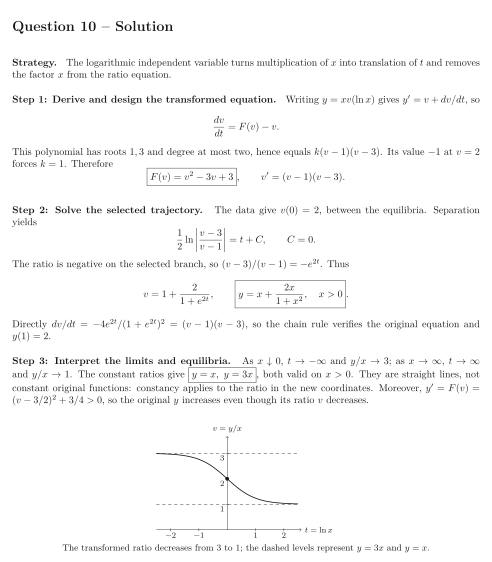
Question 10
For a homogeneous equation on , introduce the logarithmic independent variable and the ratio .
We want to be a polynomial of degree at most two such that, in the transformed equation, and are equilibrium values and when .
Tasks
Derive the equation for in terms of and .
Determine the unique polynomial satisfying the design requirements.
Solve the resulting original IVP with , showing the transformed integration and recovery of .
Find the limits of as and as . Identify the original solutions represented by the equilibrium ratios and explain why they are not constant functions . Decide whether the selected original increases or decreases.
Show solutionHide solution
Question 10 – Solution
Strategy. The logarithmic independent variable turns multiplication of into translation of and removes the factor from the ratio equation.
Step 1: Derive and design the transformed equation. Writing gives , so This polynomial has roots and degree at most two, hence equals . Its value at forces . Therefore
Step 2: Solve the selected trajectory. The data give , between the equilibria. Separation yields The ratio is negative on the selected branch, so . Thus Directly , so the chain rule verifies the original equation and .
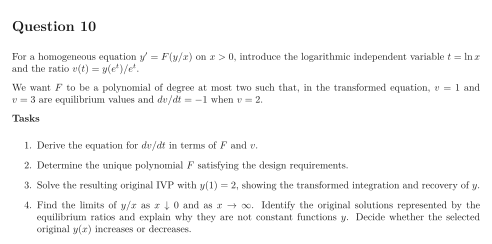
Step 3: Interpret the limits and equilibria. As , and ; as , and . The constant ratios give , both valid on . They are straight lines, not constant original functions: constancy applies to the ratio in the new coordinates. Moreover, , so the original increases even though its ratio decreases.
See the diagram in the original worksheet below.