Question 9
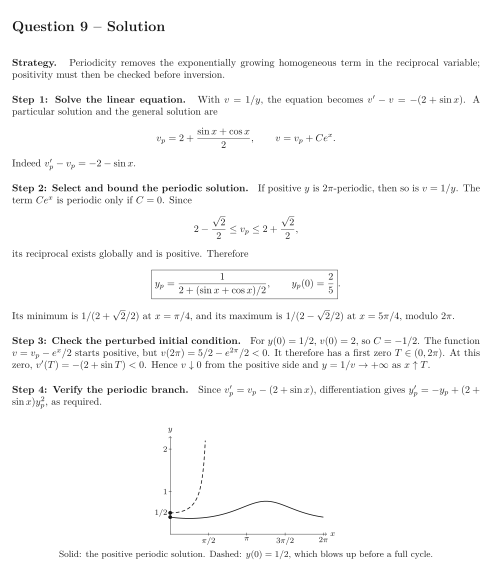
Seek strictly positive, -periodic solutions, defined for every real , of
Tasks
Use the reciprocal substitution to find the general transformed solution.
Prove that there is exactly one strictly positive -periodic solution and find its initial value at .
Determine its minimum and maximum over one period.
Show that changing the initial value to causes a finite positive-time blow-up, even though the periodic solution remains bounded. Verify the original equation for the periodic solution.
Show solutionHide solution
Question 9 – Solution
Strategy. Periodicity removes the exponentially growing homogeneous term in the reciprocal variable; positivity must then be checked before inversion.
Step 1: Solve the linear equation. With , the equation becomes . A particular solution and the general solution are Indeed .
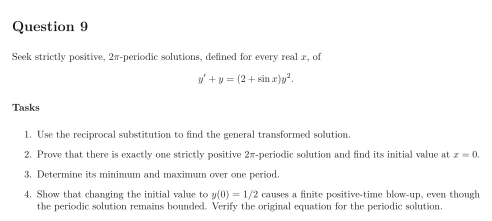
Step 2: Select and bound the periodic solution. If positive is -periodic, then so is . The term is periodic only if . Since its reciprocal exists globally and is positive. Therefore Its minimum is at , and its maximum is at , modulo .
Step 3: Check the perturbed initial condition. For , , so . The function starts positive, but . It therefore has a first zero . At this zero, . Hence from the positive side and as .
Step 4: Verify the periodic branch. Since , differentiation gives , as required.
See the diagram in the original worksheet below.