Question 7
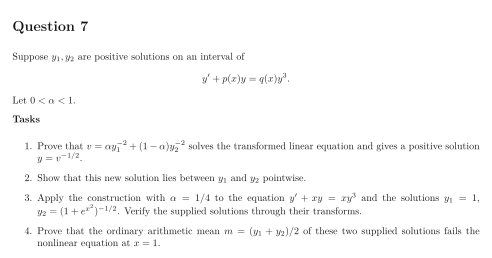
Suppose are positive solutions on an interval of Let .
Tasks
Prove that solves the transformed linear equation and gives a positive solution .
Show that this new solution lies between and pointwise.
Apply the construction with to the equation and the solutions , . Verify the supplied solutions through their transforms.
Prove that the ordinary arithmetic mean of these two supplied solutions fails the nonlinear equation at .
Show solutionHide solution
Question 7 – Solution
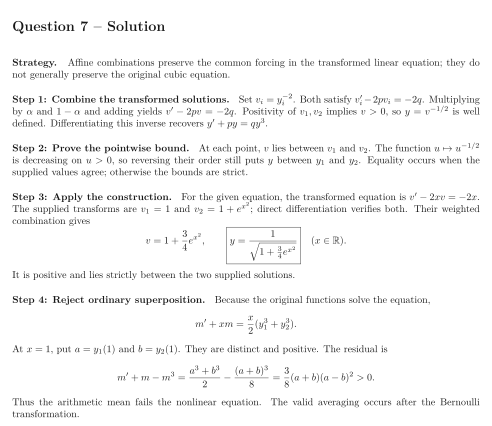
Strategy. Affine combinations preserve the common forcing in the transformed linear equation; they do not generally preserve the original cubic equation.
Step 1: Combine the transformed solutions. Set . Both satisfy . Multiplying by and and adding yields . Positivity of implies , so is well defined. Differentiating this inverse recovers .
Step 2: Prove the pointwise bound. At each point, lies between and . The function is decreasing on , so reversing their order still puts between and . Equality occurs when the supplied values agree; otherwise the bounds are strict.
Step 3: Apply the construction. For the given equation, the transformed equation is . The supplied transforms are and ; direct differentiation verifies both. Their weighted combination gives It is positive and lies strictly between the two supplied solutions.
Step 4: Reject ordinary superposition. Because the original functions solve the equation, At , put and . They are distinct and positive. The residual is Thus the arithmetic mean fails the nonlinear equation. The valid averaging occurs after the Bernoulli transformation.