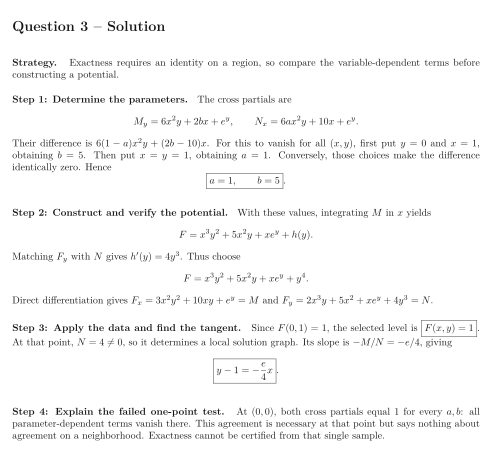
Question 3
Let . Consider
Tasks
Determine every pair for which the form is exact on . Explain why testing equality at a single point is insufficient.
For those parameters, construct a potential and verify both of its first partial derivatives.
Find the implicit solution through and its tangent line there.
A student checks only at and accepts every pair . Show why that check cannot distinguish any of the parameters.
Show solutionHide solution
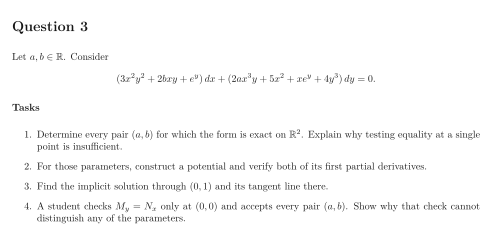
Question 3 – Solution
Strategy. Exactness requires an identity on a region, so compare the variable-dependent terms before constructing a potential.
Step 1: Determine the parameters. The cross partials are Their difference is . For this to vanish for all , first put and , obtaining . Then put , obtaining . Conversely, those choices make the difference identically zero. Hence
Step 2: Construct and verify the potential. With these values, integrating in yields Matching with gives . Thus choose Direct differentiation gives and .
Step 3: Apply the data and find the tangent. Since , the selected level is . At that point, , so it determines a local solution graph. Its slope is , giving
Step 4: Explain the failed one-point test. At , both cross partials equal for every : all parameter-dependent terms vanish there. This agreement is necessary at that point but says nothing about agreement on a neighborhood. Exactness cannot be certified from that single sample.