Question 9
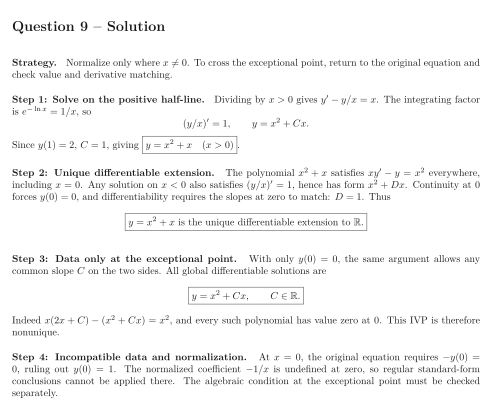
The equation has a vanishing leading coefficient at . Initially impose .
Tasks
Solve the IVP on using an integrating factor after normalization.
Determine whether this solution extends to a differentiable solution of the original equation on all of . If so, prove that such an extension is unique.
Now discard and prescribe only . Determine all differentiable solutions on satisfying this new initial condition.
Decide whether a differentiable solution with can exist. Explain why dividing by and invoking a regular standard-form IVP at would be invalid.
Show solutionHide solution
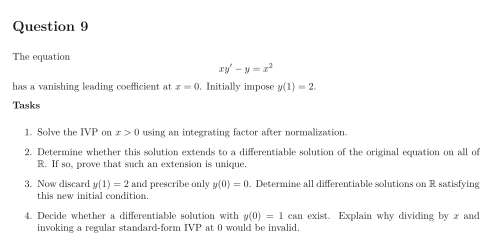
Question 9 – Solution
Strategy. Normalize only where . To cross the exceptional point, return to the original equation and check value and derivative matching.
Step 1: Solve on the positive half-line. Dividing by gives . The integrating factor is , so Since , , giving .
Step 2: Unique differentiable extension. The polynomial satisfies everywhere, including . Any solution on also satisfies , hence has form . Continuity at forces , and differentiability requires the slopes at zero to match: . Thus
Step 3: Data only at the exceptional point. With only , the same argument allows any common slope on the two sides. All global differentiable solutions are Indeed , and every such polynomial has value zero at . This IVP is therefore nonunique.
Step 4: Incompatible data and normalization. At , the original equation requires , ruling out . The normalized coefficient is undefined at zero, so regular standard-form conclusions cannot be applied there. The algebraic condition at the exceptional point must be checked separately.