Question 1
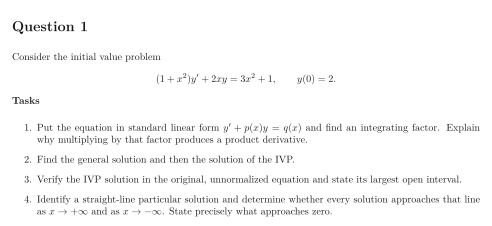
Consider the initial value problem Tasks
Put the equation in standard linear form and find an integrating factor. Explain why multiplying by that factor produces a product derivative.
Find the general solution and then the solution of the IVP.
Verify the IVP solution in the original, unnormalized equation and state its largest open interval.
Identify a straight-line particular solution and determine whether every solution approaches that line as and as . State precisely what approaches zero.
Show solutionHide solution
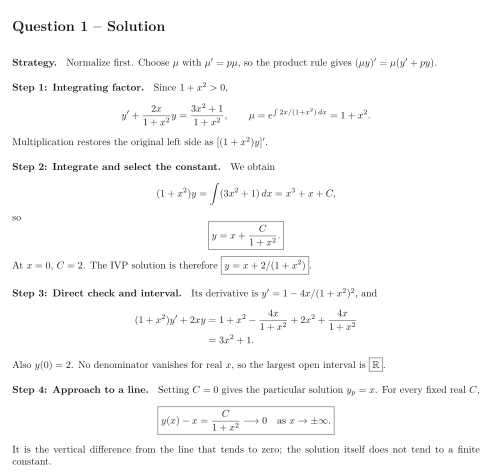
Question 1 – Solution
Strategy. Normalize first. Choose with , so the product rule gives .
Step 1: Integrating factor. Since , Multiplication restores the original left side as .
Step 2: Integrate and select the constant. We obtain so At , . The IVP solution is therefore .
Step 3: Direct check and interval. Its derivative is , and Also . No denominator vanishes for real , so the largest open interval is .
Step 4: Approach to a line. Setting gives the particular solution . For every fixed real , It is the vertical difference from the line that tends to zero; the solution itself does not tend to a finite constant.