Question 6
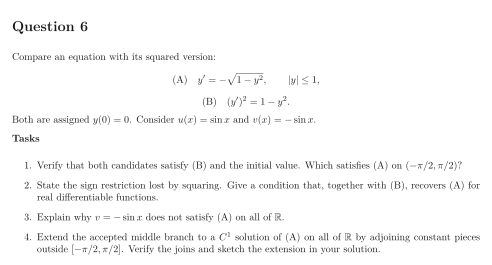
Compare an equation with its squared version: Both are assigned . Consider and .
Tasks
Verify that both candidates satisfy (B) and the initial value. Which satisfies (A) on ?
State the sign restriction lost by squaring. Give a condition that, together with (B), recovers (A) for real differentiable functions.
Explain why does not satisfy (A) on all of .
Extend the accepted middle branch to a solution of (A) on all of by adjoining constant pieces outside . Verify the joins and sketch the extension in your solution.
Show solutionHide solution
Question 6 – Solution
Strategy. Squaring forgets a sign. Restore that sign when selecting a branch, and check differentiability when extending it.
Step 1: Compare the candidates. Both satisfy and have value zero at . On , , so the right-hand side of (A) is . Hence
Step 2: Recover the lost information. Equation (A) forces . Conversely, (B) and imply and . Outside the middle interval, is positive wherever , so fails (A) there.
Step 3: A global extension. Define
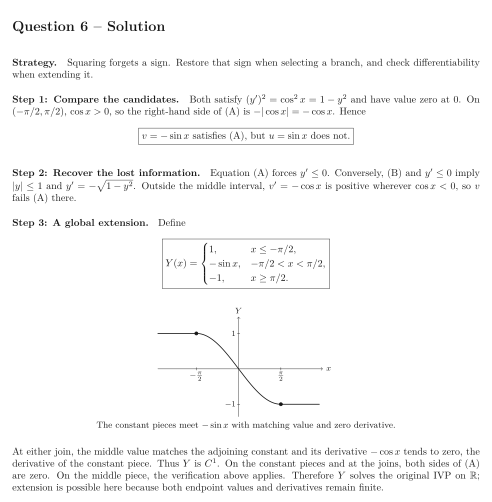
See the diagram in the original worksheet below.
At either join, the middle value matches the adjoining constant and its derivative tends to zero, the derivative of the constant piece. Thus is . On the constant pieces and at the joins, both sides of (A) are zero. On the middle piece, the verification above applies. Therefore solves the original IVP on ; extension is possible here because both endpoint values and derivatives remain finite.