Question 4
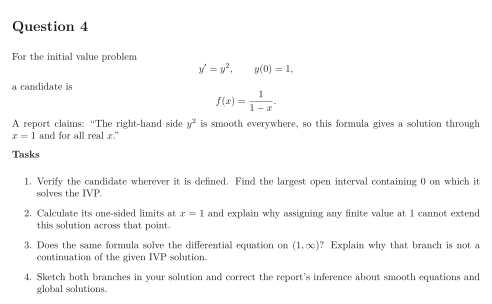
For the initial value problem a candidate is A report claims: “The right-hand side is smooth everywhere, so this formula gives a solution through and for all real .”
Tasks
Verify the candidate wherever it is defined. Find the largest open interval containing on which it solves the IVP.
Calculate its one-sided limits at and explain why assigning any finite value at cannot extend this solution across that point.
Does the same formula solve the differential equation on ? Explain why that branch is not a continuation of the given IVP solution.
Sketch both branches in your solution and correct the report’s inference about smooth equations and global solutions.
Show solutionHide solution
Question 4 – Solution
Strategy. Check the function’s domain as well as the equation’s right-hand side. A solution can become unbounded in finite time even for a smooth equation.
Step 1: Verification and interval. For , The largest open interval containing that avoids is .
See the diagram in the original worksheet below.
Step 2: No finite extension. The limits are A differentiable extension across would be continuous there and would have a finite value. The left-hand divergence rules this out, independently of what formula is proposed after .
Step 3: The separate branch. On , the same derivative calculation still proves . This branch is a solution of the differential equation, but its interval does not contain the initial point and cannot be joined through to the IVP branch.
Step 4: Corrected inference. Smoothness of a right-hand side is not a guarantee of existence for all time. Here the equation is defined at every finite pair , but the IVP solution escapes to unbounded as . The failure belongs to global continuation of the solution, not to a singularity of at a finite point.
