Question 2
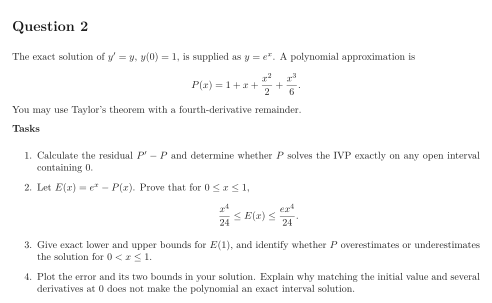
The exact solution of , , is supplied as . A polynomial approximation is You may use Taylor’s theorem with a fourth-derivative remainder.
Tasks
Calculate the residual and determine whether solves the IVP exactly on any open interval containing .
Let . Prove that for ,
Give exact lower and upper bounds for , and identify whether overestimates or underestimates the solution for .
Plot the error and its two bounds in your solution. Explain why matching the initial value and several derivatives at does not make the polynomial an exact interval solution.
Show solutionHide solution
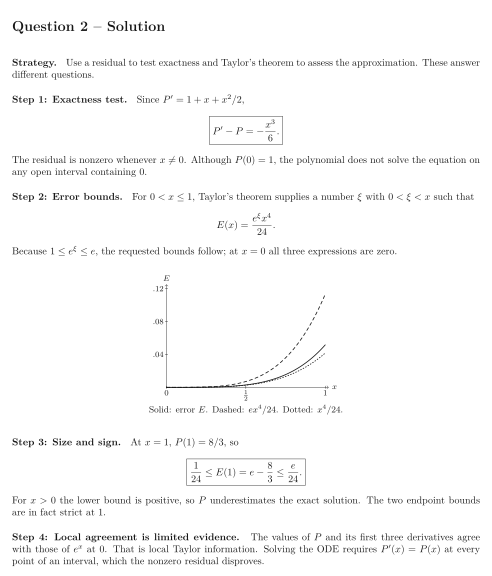
Question 2 – Solution
Strategy. Use a residual to test exactness and Taylor’s theorem to assess the approximation. These answer different questions.
Step 1: Exactness test. Since , The residual is nonzero whenever . Although , the polynomial does not solve the equation on any open interval containing .
Step 2: Error bounds. For , Taylor’s theorem supplies a number with such that Because , the requested bounds follow; at all three expressions are zero.
See the diagram in the original worksheet below.
Step 3: Size and sign. At , , so For the lower bound is positive, so underestimates the exact solution. The two endpoint bounds are in fact strict at .
Step 4: Local agreement is limited evidence. The values of and its first three derivatives agree with those of at . That is local Taylor information. Solving the ODE requires at every point of an interval, which the nonzero residual disproves.