Question 10
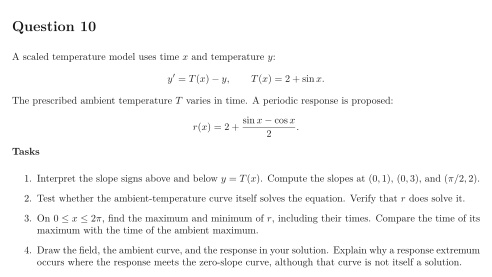
A scaled temperature model uses time and temperature : The prescribed ambient temperature varies in time. A periodic response is proposed: Tasks
Interpret the slope signs above and below . Compute the slopes at , , and .
Test whether the ambient-temperature curve itself solves the equation. Verify that does solve it.
On , find the maximum and minimum of , including their times. Compare the time of its maximum with the time of the ambient maximum.
Draw the field, the ambient curve, and the response in your solution. Explain why a response extremum occurs where the response meets the zero-slope curve, although that curve is not itself a solution.
Show solutionHide solution
Question 10 – Solution
Strategy. Interpret the moving zero-slope curve as a temperature comparison, then verify the response and locate its horizontal tangents.
Step 1: Heating and cooling. Below , and the object warms; above it, and it cools. At the three listed points, the slopes are .
Step 2: Check both curves. Along the right-hand side is zero, but is not identically zero on any interval. Thus is not a solution. By contrast, so is a solution for all real .
See the diagram in the original worksheet below.
Step 3: Extrema and delay. Rewrite On the stated interval, its extreme values are The endpoint values both equal and lie between these extremes. The ambient maximum occurs at , so the response maximum follows it by time units.
Step 4: Field interpretation. At a response extremum, , so the response meets the zero-slope curve. Elsewhere it need not equal . A locus of zero assigned slopes can move with time without being a solution curve itself.
