Question 10
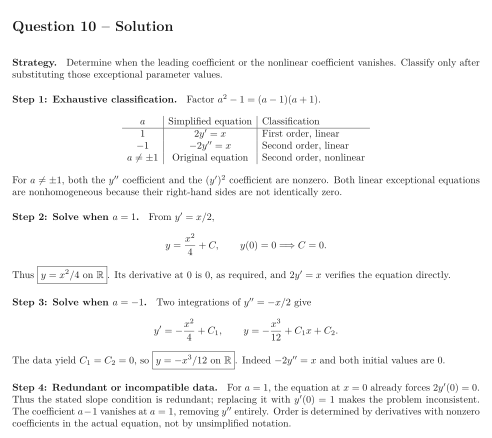
Let be a fixed parameter in the equation The proposed initial data are Tasks
Classify the equation’s order and linearity for every real value of . Simplify the exceptional cases before classifying them.
For each parameter value that makes the equation linear, find all solutions satisfying the proposed data using elementary integration.
For , decide whether supplies independent information beyond the equation. What happens if this condition is replaced by ?
Explain why the mere appearance of the symbol in a parameterized formula does not guarantee that every member is a second-order equation.
Show solutionHide solution
Question 10 – Solution
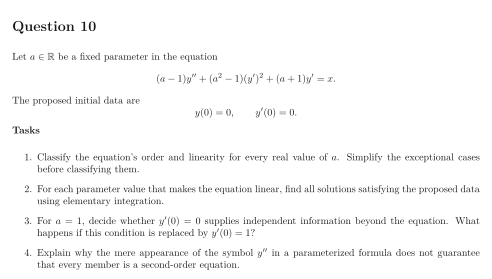
Strategy. Determine when the leading coefficient or the nonlinear coefficient vanishes. Classify only after substituting those exceptional parameter values.
Step 1: Exhaustive classification. Factor . For , both the coefficient and the coefficient are nonzero. Both linear exceptional equations are nonhomogeneous because their right-hand sides are not identically zero.
Step 2: Solve when . From , Thus . Its derivative at is , as required, and verifies the equation directly.
Step 3: Solve when . Two integrations of give The data yield , so . Indeed and both initial values are .
Step 4: Redundant or incompatible data. For , the equation at already forces . Thus the stated slope condition is redundant; replacing it with makes the problem inconsistent. The coefficient vanishes at , removing entirely. Order is determined by derivatives with nonzero coefficients in the actual equation, not by unsimplified notation.