Divergence Theorem — Question 3

PDF ↗

Question 3

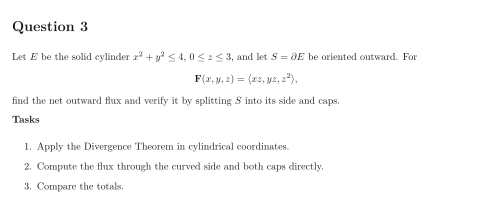
Let EE be the solid cylinder x2+y2≤4x^2+y^2\le 4, 0≤z≤30\le z\le 3, and let S=∂ES=\partial E be oriented outward. For 𝑭(x,y,z)=⟨xz,yz,z2⟩,\mathbf F(x,y,z)=\langle xz,yz,z^2\rangle, find the net outward flux and verify it by splitting SS into its side and caps.

Tasks

  1. Apply the Divergence Theorem in cylindrical coordinates.

  2. Compute the flux through the curved side and both caps directly.

  3. Compare the totals.

Original worksheet page 1: question and worked solution for 6-6-003
Show solutionHide solution

Question 3 – Solution

Strategy. First obtain the net flux from the divergence, then use the simple normals of a cylinder as an independent check.

Step 1: Volume integral Since ∇⋅𝑭=z+z+2z=4z,\nabla\cdot\mathbf F=z+z+2z=4z, we obtain ∬S𝑭⋅𝒏dS=∫02π∫02∫034zrdzdrdθ=72π.\begin{align*} \iint_S\mathbf F\cdot\mathbf n\,dS &=\int_0^{2\pi}\int_0^2\int_0^3 4z\,r\,dz\,dr\,d\theta\\ &=\boxed{72\pi}. \end{align*}

See the diagram in the original worksheet below.

Step 2: Curved side On r=2r=2, the outward vector element is ⟨2cos⁡θ,2sin⁡θ,0⟩dθdz\langle 2\cos\theta,2\sin\theta,0\rangle\,d\theta\,dz. Thus the dot product is 4z4z, and Φside=∫02π∫034zdzdθ=36π.\Phi_{\mathrm{side}}=\int_0^{2\pi}\int_0^3 4z\,dz\,d\theta=36\pi.

Step 3: Caps On the top z=3z=3, 𝑭⋅𝒌=9\mathbf F\cdot\mathbf k=9, so Φtop=9(4π)=36π\Phi_{\mathrm{top}}=9(4\pi)=36\pi. On the bottom, z=0z=0, so Φbottom=0\Phi_{\mathrm{bottom}}=0. Φside+Φtop+Φbottom=72π.\boxed{\Phi_{\mathrm{side}}+\Phi_{\mathrm{top}}+\Phi_{\mathrm{bottom}}=72\pi}.

Verification The direct total matches the volume-integral result exactly.

Original worksheet page 2: question and worked solution for 6-6-003

Original worksheet layout. Use Enlarge or open the PDF for a closer view.