Divergence Theorem β€” Question 1

PDF β†—

Question 1

Let SS be the sphere x2+y2+z2=4x^2+y^2+z^2=4, oriented outward, and let 𝑭(x,y,z)=⟨x,y,z⟩.\mathbf F(x,y,z)=\langle x,y,z\rangle.

Tasks

  1. Compute βˆ‡β‹…π‘­\nabla\cdot\mathbf F.

  2. Use the Divergence Theorem to find the outward flux through SS.

  3. Verify the result directly from the geometry of the sphere.
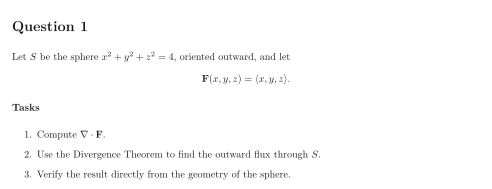
Original worksheet page 1: question and worked solution for 6-6-001
Show solutionHide solution

Question 1 – Solution

Strategy. Replace the closed-surface flux by a volume integral over the radius-22 ball.

Step 1: Divergence βˆ‡β‹…π‘­=1+1+1=3.\boxed{\nabla\cdot\mathbf F=1+1+1=3}. If EE is the ball bounded by SS, then vol⁡(E)=43Ο€(23)=32Ο€3.\operatorname{vol}(E)=\frac 43\pi(2^3)=\frac{32\pi}{3}.

See the diagram in the original worksheet below.

Step 2: Apply the theorem ∬S𝑭⋅𝒏dS=∭E3dV=3(32Ο€3)=32Ο€.\boxed{\iint_S\mathbf F\cdot\mathbf n\,dS =\iiint_E3\,dV=3\left(\frac{32\pi}{3}\right)=32\pi}.

Step 3: Direct check On the sphere, the outward unit normal is 𝒏=⟨x,y,z⟩/2\mathbf n=\langle x,y,z\rangle/2. Therefore 𝑭⋅𝒏=x2+y2+z22=2.\mathbf F\cdot\mathbf n=\frac{x^2+y^2+z^2}{2}=2. Multiplying by the surface area 4Ο€(22)=16Ο€4\pi(2^2)=16\pi gives 2(16Ο€)=32Ο€2(16\pi)=32\pi.

Verification The radial field points outward everywhere, so the positive sign is required.
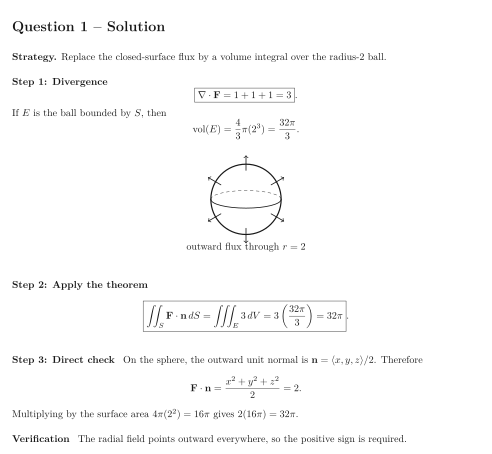
Original worksheet page 2: question and worked solution for 6-6-001

Original worksheet layout. Use Enlarge or open the PDF for a closer view.