Stokes' Theorem — Question 1

PDF ↗

Question 1

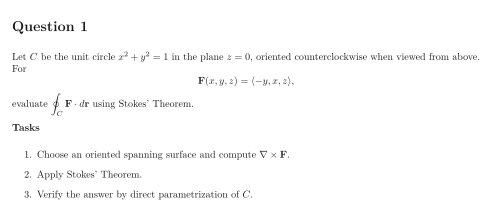
Let CC be the unit circle x2+y2=1x^2+y^2=1 in the plane z=0z=0, oriented counterclockwise when viewed from above. For 𝑭(x,y,z)=⟨−y,x,z⟩,\mathbf F(x,y,z)=\langle-y,x,z\rangle, evaluate ∮C𝑭⋅d𝒓\displaystyle\oint_C\mathbf F\cdot d\mathbf r using Stokes’ Theorem.

Tasks

  1. Choose an oriented spanning surface and compute ∇×𝑭\nabla\times\mathbf F.

  2. Apply Stokes’ Theorem.

  3. Verify the answer by direct parametrization of CC.

Original worksheet page 1: question and worked solution for 6-5-001
Show solutionHide solution

Question 1 – Solution

Strategy. Span the circle by its flat disk; the prescribed counterclockwise direction selects the upward normal.

Step 1: Curl and orientation ∇×𝑭=∣𝒊𝒋𝒌∂x∂y∂z−yxz∣=⟨0,0,2⟩.\nabla\times\mathbf F =\begin{vmatrix}\mathbf i&\mathbf j&\mathbf k\\ \partial_x&\partial_y&\partial_z\\-y&x&z\end{vmatrix} =\langle 0,0,2\rangle. Let SS be the unit disk with 𝒏=𝒌\mathbf n=\mathbf k.

See the diagram in the original worksheet below.

Step 2: Apply Stokes ∮C𝑭⋅d𝒓=∬S(∇×𝑭)⋅𝒏dS=∬S2dA=2π.\boxed{\oint_C\mathbf F\cdot d\mathbf r =\iint_S(\nabla\times\mathbf F)\cdot\mathbf n\,dS =\iint_S2\,dA=2\pi}.

Step 3: Direct check With 𝒓(t)=⟨cos⁡t,sin⁡t,0⟩\mathbf r(t)=\langle\cos t,\sin t,0\rangle, 𝑭(𝒓(t))=⟨−sin⁡t,cos⁡t,0⟩=𝒓′(t).\mathbf F(\mathbf r(t))=\langle-\sin t,\cos t,0\rangle =\mathbf r'(t). Therefore ∫02π𝑭⋅𝒓′dt=∫02π1dt=2π\int_0^{2\pi}\mathbf F\cdot\mathbf r'\,dt=\int_0^{2\pi}1\,dt=2\pi.

Verification The boundary is counterclockwise from the tip of 𝒌\mathbf k, so the orientation pairing is correct.

Original worksheet page 2: question and worked solution for 6-5-001

Original worksheet layout. Use Enlarge or open the PDF for a closer view.