Question 10
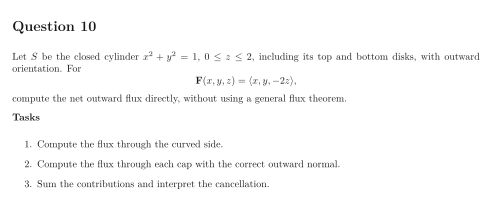
Let be the closed cylinder , , including its top and bottom disks, with outward orientation. For compute the net outward flux directly, without using a general flux theorem.
Tasks
Compute the flux through the curved side.
Compute the flux through each cap with the correct outward normal.
Sum the contributions and interpret the cancellation.
Show solutionHide solution
Question 10 – Solution
Strategy. Decompose the closed surface into three oriented pieces and track the outward normal on each one.
Step 1: Curved side Parametrize by The outward vector element is . Its dot product with is , so
See the diagram in the original worksheet below.
Step 2: Caps On the top disk , the outward normal is , and Thus . On the bottom disk , the outward normal is , but the vertical field component is zero, so .
Step 3: Net flux
Verification The side carries units outward while the top carries the same amount inward; the signed balance is zero even though neither contribution vanishes.
