Surface Integrals of Vector Fields β€” Question 5

PDF β†—

Question 5

Let SS be the lateral cone z=x2+y2,0≀z≀2,z=\sqrt{x^2+y^2},\qquad 0\le z\le 2, oriented away from the zz-axis. For 𝑭=⟨0,0,z⟩\mathbf F=\langle 0,0,z\rangle, compute the flux across SS.

Tasks

  1. Parametrize the cone and choose the requested orientation.

  2. Evaluate the oriented surface integral.

  3. Address the singular parameter point at the cone’s vertex.
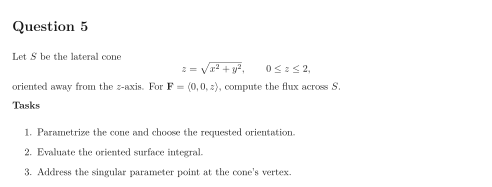
Original worksheet page 1: question and worked solution for 6-4-005
Show solutionHide solution

Question 5 – Solution

Strategy. The normal pointing horizontally away from the axis also has a downward vertical component, which determines the sign of the flux.

Step 1: Oriented cross product Use 𝒓(u,v)=⟨ucos⁡v,usin⁡v,u⟩,0≀u≀2,0≀v≀2Ο€.\mathbf r(u,v)=\langle u\cos v,u\sin v,u\rangle, \quad 0\le u\le 2,\quad 0\le v\le 2\pi. The ordered product 𝒓v×𝒓u=⟨ucos⁡v,usin⁡v,βˆ’u⟩\boxed{\mathbf r_v\times\mathbf r_u =\langle u\cos v,u\sin v,-u\rangle} has a radial component pointing away from the axis.

See the diagram in the original worksheet below.

Step 2: Integrate On the cone, 𝑭=⟨0,0,u⟩\mathbf F=\langle 0,0,u\rangle, so 𝑭⋅(𝒓v×𝒓u)=βˆ’u2.\mathbf F\cdot(\mathbf r_v\times\mathbf r_u)=-u^2. Therefore ∬S𝑭⋅𝒏dS=∫02Ο€βˆ«02βˆ’u2dudv=βˆ’16Ο€3.\begin{align*} \iint_S\mathbf F\cdot\mathbf n\,dS &=\int_0^{2\pi}\int_0^2-u^2\,du\,dv\\ &=\boxed{-\frac{16\pi}{3}}. \end{align*}

Step 3: Vertex The parametrization is singular at u=0u=0, but that single surface point has zero area. Equivalently, integrate over Ρ≀u≀2\varepsilon\le u\le 2 and let Ξ΅β†’0+\varepsilon\to 0^+.

Verification The chosen normal has negative zz-component while the field points upward, so a negative flux is required.

Original worksheet page 2: question and worked solution for 6-4-005

Original worksheet layout. Use Enlarge or open the PDF for a closer view.