Surface Integrals of Vector Fields β€” Question 1

PDF β†—

Question 1

Let SS be the part of the plane z=1+x+yz=1+x+y above the unit square 0≀x,y≀10\le x,y\le 1, oriented upward. Let 𝑭(x,y,z)=⟨x,y,z⟩.\mathbf F(x,y,z)=\langle x,y,z\rangle.

Tasks

  1. Find the upward-oriented vector surface element.

  2. Compute the flux ∬S𝑭⋅𝒏dS\displaystyle\iint_S\mathbf F\cdot\mathbf n\,dS.

  3. State how the result changes under downward orientation.
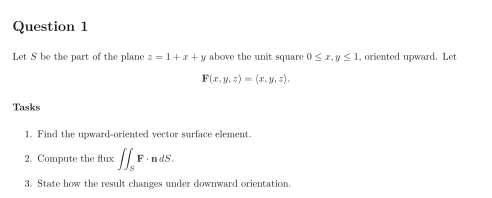
Original worksheet page 1: question and worked solution for 6-4-001
Show solutionHide solution

Question 1 – Solution

Strategy. Parametrize the graph by (x,y)(x,y) and retain the cross product itself, not merely its magnitude.

Step 1: Oriented element Use 𝒓(x,y)=⟨x,y,1+x+y⟩.\mathbf r(x,y)=\langle x,y,1+x+y\rangle. Then 𝒓x=⟨1,0,1⟩,𝒓y=⟨0,1,1⟩,\mathbf r_x=\langle 1,0,1\rangle,\qquad \mathbf r_y=\langle 0,1,1\rangle, so the upward vector area element is 𝒏dS=(𝒓x×𝒓y)dxdy=βŸ¨βˆ’1,βˆ’1,1⟩dxdy.\boxed{\mathbf n\,dS=(\mathbf r_x\times\mathbf r_y)\,dx\,dy =\langle-1,-1,1\rangle\,dx\,dy}.

See the diagram in the original worksheet below.

Step 2: Dot product On the surface, z=1+x+yz=1+x+y, and hence 𝑭⋅(𝒓x×𝒓y)=βˆ’xβˆ’y+z=1.\mathbf F\cdot(\mathbf r_x\times\mathbf r_y) =-x-y+z=1. Therefore ∬S𝑭⋅𝒏dS=∫01∫011dxdy=1.\boxed{\iint_S\mathbf F\cdot\mathbf n\,dS =\int_0^1\int_0^1 1\,dx\,dy=1}.

Step 3: Reverse orientation A downward normal is the negative of the chosen one, so the downward flux is βˆ’1\boxed{-1}.

Verification The cross product has positive third component, confirming the upward orientation; changing only the orientation must negate a flux integral.

Original worksheet page 2: question and worked solution for 6-4-001

Original worksheet layout. Use Enlarge or open the PDF for a closer view.