Surface Integrals — Question 3

PDF ↗

Question 3

A thin surface occupies the lateral cylinder S:x2+y2=4,0≤z≤3,S:\ x^2+y^2=4,\qquad 0\le z\le 3, with surface density δ(x,y,z)=1+z\delta(x,y,z)=1+z.

Tasks

  1. Parametrize SS and compute its surface element.

  2. Find the total mass.

  3. Find the center of mass, using symmetry where appropriate.
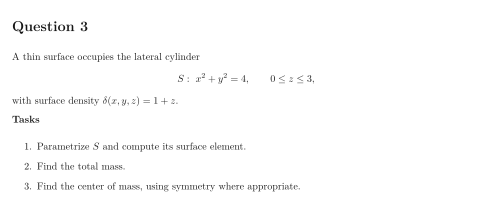
Original worksheet page 1: question and worked solution for 6-3-003
Show solutionHide solution

Question 3 – Solution

Strategy. Parametrize by angle and height. Rotational symmetry immediately locates two coordinates of the center of mass.

Step 1: Geometry 𝒓(θ,z)=⟨2cos⁡θ,2sin⁡θ,z⟩,0≤θ≤2π,0≤z≤3.\mathbf r(\theta,z)=\langle 2\cos\theta,2\sin\theta,z\rangle, \quad 0\le\theta\le 2\pi,\quad 0\le z\le 3. Since ‖𝒓θ×𝒓z‖=2\lVert\mathbf r_\theta\times\mathbf r_z\rVert=2, dS=2dθdz.\boxed{dS=2\,d\theta\,dz}.

See the diagram in the original worksheet below.

Step 2: Mass M=∫02π∫03(1+z)2dzdθ=4π[z+z22]03=30π.\begin{align*} M&=\int_0^{2\pi}\int_0^3(1+z)2\,dz\,d\theta\\ &=4\pi\left[z+\frac{z^2}{2}\right]_0^3=\boxed{30\pi}. \end{align*}

Step 3: Center of mass Symmetry gives x‾=y‾=0\bar x=\bar y=0. The first moment about the xyxy-plane is Mxy=∫02π∫03z(1+z)2dzdθ=4π[z22+z33]03=54π.\begin{align*} M_{xy}&=\int_0^{2\pi}\int_0^3 z(1+z)2\,dz\,d\theta\\ &=4\pi\left[\frac{z^2}{2}+\frac{z^3}{3}\right]_0^3=54\pi. \end{align*} Thus (x‾,y‾,z‾)=(0,0,95).\boxed{(\bar x,\bar y,\bar z)=\left(0,0,\frac 95\right)}.

Verification Because density increases with height, z‾=1.8\bar z=1.8 is correctly above the geometric midpoint 1.51.5 and remains inside 0≤z≤30\le z\le 3.

Original worksheet page 2: question and worked solution for 6-3-003

Original worksheet layout. Use Enlarge or open the PDF for a closer view.