Parametric Surfaces — Question 6

PDF ↗

Question 6

Analyze the parametrized surface 𝒓(u,v)=⟨ucos⁡v,usin⁡v,v⟩,0≤u≤2,0≤v≤2π.\mathbf r(u,v)=\langle u\cos v,u\sin v,v\rangle, \qquad 0\le u\le 2,\qquad 0\le v\le 2\pi.

Tasks

  1. Identify the surface geometrically.

  2. Describe the coordinate curves u=constantu=\text{constant} and v=constantv=\text{constant}.

  3. Test regularity on the entire parameter domain.
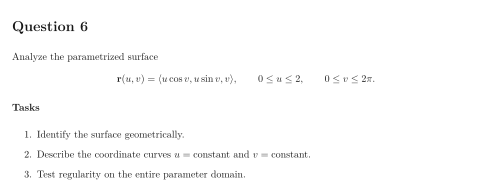
Original worksheet page 1: question and worked solution for 6-2-006
Show solutionHide solution

Question 6 – Solution

Strategy. Interpret radius, angle, and height directly, then test the tangent cross product.

Step 1: Identify In cylindrical terms, ρ=u,θ=v,z=v.\rho=u, \qquad\theta=v, \qquad z=v. As the angle increases, height increases at the same rate; the image is a helicoid patch.

See the diagram in the original worksheet below.

Step 2: Coordinate curves If u=u0u=u_0, then ⟨u0cos⁡v,u0sin⁡v,v⟩\langle u_0\cos v,u_0\sin v,v\rangle is a helix of radius u0u_0; for u0=0u_0=0 it is the zz-axis. If v=v0v=v_0, varying uu traces a radial line segment at height z=v0z=v_0.

Step 3: Regularity 𝒓u=⟨cos⁡v,sin⁡v,0⟩,𝒓v=⟨−usin⁡v,ucos⁡v,1⟩,\mathbf r_u=\langle\cos v,\sin v,0\rangle, \qquad \mathbf r_v=\langle-u\sin v,u\cos v,1\rangle, and 𝒓u×𝒓v=⟨sin⁡v,−cos⁡v,u⟩.\boxed{\mathbf r_u\times\mathbf r_v=\langle\sin v,-\cos v,u\rangle}. Its magnitude is 1+u2>0\sqrt{1+u^2}>0, even at u=0u=0, so the parametrization is regular everywhere.

Verification The first two components of the cross product have squared sum 11, preventing the normal from vanishing.
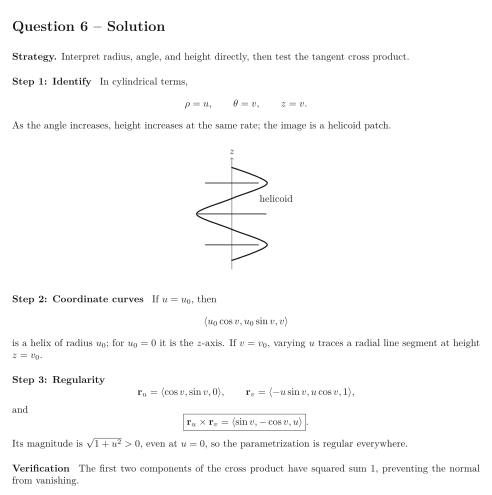
Original worksheet page 2: question and worked solution for 6-2-006

Original worksheet layout. Use Enlarge or open the PDF for a closer view.