Curl and Divergence — Question 4

PDF ↗

Question 4

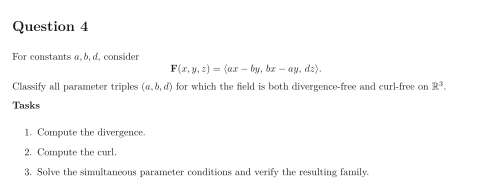
For constants a,b,da,b,d, consider 𝑭(x,y,z)=⟨ax−by,bx−ay,dz⟩.\mathbf F(x,y,z)=\langle ax-by,\,bx-ay,\,dz\rangle. Classify all parameter triples (a,b,d)(a,b,d) for which the field is both divergence-free and curl-free on ℝ3\mathbb R^3.

Tasks

  1. Compute the divergence.

  2. Compute the curl.

  3. Solve the simultaneous parameter conditions and verify the resulting family.
Original worksheet page 1: question and worked solution for 6-1-004
Show solutionHide solution

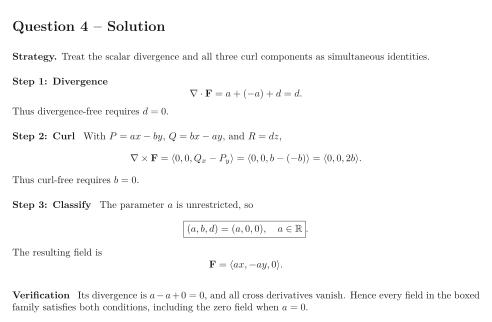
Question 4 – Solution

Strategy. Treat the scalar divergence and all three curl components as simultaneous identities.

Step 1: Divergence ∇⋅𝑭=a+(−a)+d=d.\nabla\cdot\mathbf F=a+(-a)+d=d. Thus divergence-free requires d=0d=0.

Step 2: Curl With P=ax−byP=ax-by, Q=bx−ayQ=bx-ay, and R=dzR=dz, ∇×𝑭=⟨0,0,Qx−Py⟩=⟨0,0,b−(−b)⟩=⟨0,0,2b⟩.\nabla\times\mathbf F =\langle 0,0,Q_x-P_y\rangle =\langle 0,0,b-(-b)\rangle =\langle 0,0,2b\rangle. Thus curl-free requires b=0b=0.

Step 3: Classify The parameter aa is unrestricted, so (a,b,d)=(a,0,0),a∈ℝ.\boxed{(a,b,d)=(a,0,0),\quad a\in\mathbb R}. The resulting field is 𝑭=⟨ax,−ay,0⟩.\mathbf F=\langle ax,-ay,0\rangle.

Verification Its divergence is a−a+0=0a-a+0=0, and all cross derivatives vanish. Hence every field in the boxed family satisfies both conditions, including the zero field when a=0a=0.

Original worksheet page 2: question and worked solution for 6-1-004

Original worksheet layout. Use Enlarge or open the PDF for a closer view.