Question 2
Consider the position field
Tasks
Compute its divergence and curl.
Interpret the divergence as local expansion or contraction.
Explain why the field has no local rotational tendency.
Show solutionHide solution
Question 2 – Solution
Strategy. Differentiate the matching coordinate in each divergence term and compare the cross derivatives for curl.
Step 1: Divergence
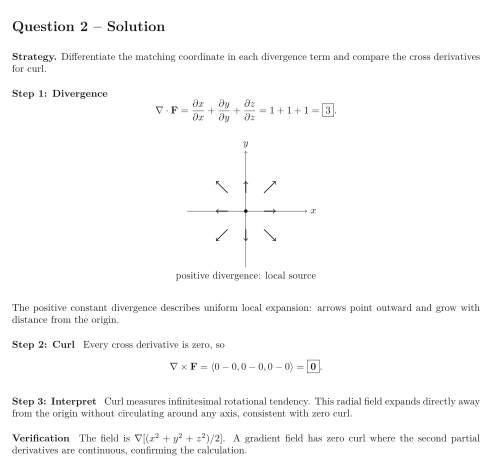
See the diagram in the original worksheet below.
The positive constant divergence describes uniform local expansion: arrows point outward and grow with distance from the origin.
Step 2: Curl Every cross derivative is zero, so
Step 3: Interpret Curl measures infinitesimal rotational tendency. This radial field expands directly away from the origin without circulating around any axis, consistent with zero curl.
Verification The field is . A gradient field has zero curl where the second partial derivatives are continuous, confirming the calculation.