Green's Theorem — Question 7

PDF ↗

Question 7

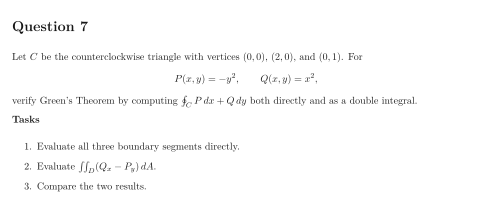
Let CC be the counterclockwise triangle with vertices (0,0)(0,0), (2,0)(2,0), and (0,1)(0,1). For P(x,y)=−y2,Q(x,y)=x2,P(x,y)=-y^2, \qquad Q(x,y)=x^2, verify Green’s Theorem by computing ∮CPdx+Qdy\oint_C P\,dx+Q\,dy both directly and as a double integral.

Tasks

  1. Evaluate all three boundary segments directly.

  2. Evaluate ∬D(Qx−Py)dA\iint_D(Q_x-P_y)\,dA.

  3. Compare the two results.

Original worksheet page 1: question and worked solution for 5-7-007
Show solutionHide solution

Question 7 – Solution

Strategy. Only the slanted edge contributes directly; then use 0≤y≤1−x/20\le y\le 1-x/2 for the interior.

Step 1: Boundary calculation The horizontal and vertical coordinate-axis edges contribute zero. Parametrize the slanted edge from (2,0)(2,0) to (0,1)(0,1) by 𝒓(t)=⟨2−2t,t⟩,0≤t≤1.\mathbf r(t)=\langle 2-2t,t\rangle,\qquad 0\le t\le 1. Then dx=−2dtdx=-2dt, dy=dtdy=dt, and ∫slantPdx+Qdy=∫01[2t2+4(1−t)2]dt=2.\int_{\mathrm{slant}}P\,dx+Q\,dy =\int_0^1\left[2t^2+4(1-t)^2\right]dt=\boxed{2}.

See the diagram in the original worksheet below.

Step 2: Interior calculation Since Qx−Py=2x+2yQ_x-P_y=2x+2y, ∬D(2x+2y)dA=∫02∫01−x/2(2x+2y)dydx=∫02(1+x−3x24)dx=2.\begin{align*} \iint_D(2x+2y)\,dA &=\int_0^2\int_0^{1-x/2}(2x+2y)\,dy\,dx\\ &=\int_0^2\left(1+x-\frac{3x^2}{4}\right)dx=\boxed{2}. \end{align*}

Verification Both methods give 22. The slanted parametrization runs from (2,0)(2,0) to (0,1)(0,1), which is the required counterclockwise direction after traversing the bottom edge.

Original worksheet page 2: question and worked solution for 5-7-007

Original worksheet layout. Use Enlarge or open the PDF for a closer view.