Conservative Vector Fields — Question 10

PDF ↗

Question 10

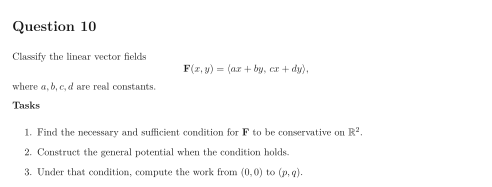
Classify the linear vector fields 𝑭(x,y)=⟨ax+by,cx+dy⟩,\mathbf F(x,y)=\langle ax+by,\,cx+dy\rangle, where a,b,c,da,b,c,d are real constants.

Tasks

  1. Find the necessary and sufficient condition for 𝑭\mathbf F to be conservative on ℝ2\mathbb R^2.

  2. Construct the general potential when the condition holds.

  3. Under that condition, compute the work from (0,0)(0,0) to (p,q)(p,q).

Original worksheet page 1: question and worked solution for 5-6-010
Show solutionHide solution

Question 10 – Solution

Strategy. Compare the constant cross partials, then integrate symbolically without assigning numerical coefficients.

Step 1: Classify Let P=ax+byP=ax+by and Q=cx+dyQ=cx+dy. Then Py=b,Qx=c.P_y=b, \qquad Q_x=c. Because ℝ2\mathbb R^2 is simply connected, equality is both necessary and sufficient. Hence 𝑭 is conservative exactly when b=c.\boxed{\mathbf F\text{ is conservative exactly when }b=c}.

Step 2: Construct the potential Assume b=cb=c. Integrating fx=ax+byf_x=ax+by gives f=a2x2+bxy+g(y).f=\frac a2x^2+bxy+g(y). Since fy=bx+g′(y)=bx+dyf_y=bx+g'(y)=bx+dy, we have g′(y)=dyg'(y)=dy, so f(x,y)=a2x2+bxy+d2y2+C.\boxed{f(x,y)=\frac a2x^2+bxy+\frac d2y^2+C}.

Step 3: Compute the work The Fundamental Theorem for Line Integrals gives ∫C𝑭⋅d𝒓=f(p,q)−f(0,0)=a2p2+bpq+d2q2.\int_C\mathbf F\cdot d\mathbf r =f(p,q)-f(0,0) =\boxed{\frac a2p^2+bpq+\frac d2q^2}.

Verification Differentiating the potential gives ⟨ax+by,bx+dy⟩\langle ax+by,bx+dy\rangle, which equals the original field precisely because c=bc=b. The additive constant cancels from the work.
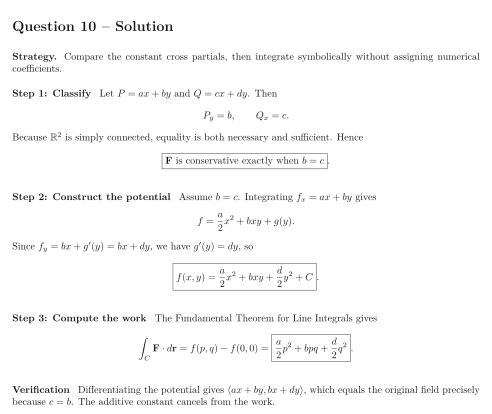
Original worksheet page 2: question and worked solution for 5-6-010

Original worksheet layout. Use Enlarge or open the PDF for a closer view.