Question 7
Suppose and are potential functions for the same continuous vector field on a connected open region .
Tasks
Prove that is constant on .
Explain why connectedness is needed.
State the resulting uniqueness principle for potential functions.
Show solutionHide solution
Question 7 – Solution
Strategy. Subtract the two gradient equations and use paths inside the connected open region.
Step 1: Subtract gradients Since , Let . An open connected region in is path connected, so choose a piecewise smooth curve in from to . Then Thus for every pair, and
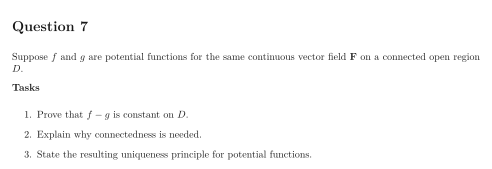
See the diagram in the original worksheet below.
Step 2: Why connectedness matters On separate components, the same zero gradient permits a different constant on each component because no path in joins them.
Step 3: Uniqueness principle A potential on a connected region is unique up to one additive constant. Adding a constant changes function values but leaves every partial derivative unchanged.
Verification If , then , confirming that every additive constant really does produce another potential.