Line Integrals - Part I — Question 10

PDF ↗

Question 10

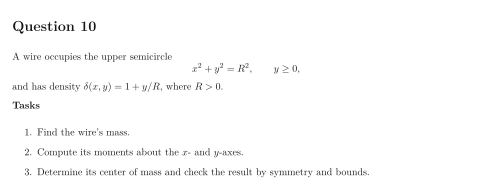
A wire occupies the upper semicircle x2+y2=R2,y≥0,x^2+y^2=R^2,\qquad y\ge 0, and has density δ(x,y)=1+y/R\delta(x,y)=1+y/R, where R>0R>0.

Tasks

  1. Find the wire’s mass.

  2. Compute its moments about the xx- and yy-axes.

  3. Determine its center of mass and check the result by symmetry and bounds.
Original worksheet page 1: question and worked solution for 5-2-010
Show solutionHide solution

Question 10 – Solution

Strategy. Parametrize by polar angle; symmetry immediately predicts that the center of mass lies on the yy-axis.

Step 1: Mass Let x=Rcos⁡θx=R\cos\theta, y=Rsin⁡θy=R\sin\theta, 0≤θ≤π0\le\theta\le\pi, so ds=Rdθds=R\,d\theta and δ=1+sin⁡θ\delta=1+\sin\theta. Then M=R∫0π(1+sin⁡θ)dθ=R(π+2).M=R\int_0^\pi(1+\sin\theta)\,d\theta =\boxed{R(\pi+2)}.

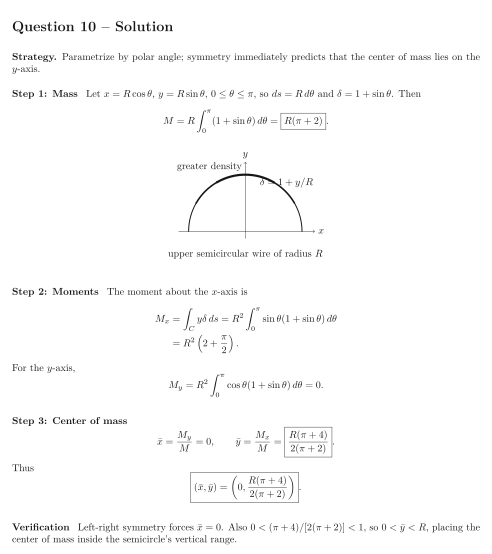
See the diagram in the original worksheet below.

Step 2: Moments The moment about the xx-axis is Mx=∫Cyδds=R2∫0πsin⁡θ(1+sin⁡θ)dθ=R2(2+π2).\begin{align*} M_x&=\int_Cy\delta\,ds =R^2\int_0^\pi\sin\theta(1+\sin\theta)\,d\theta\\ &=R^2\left(2+\frac{\pi}{2}\right). \end{align*} For the yy-axis, My=R2∫0πcos⁡θ(1+sin⁡θ)dθ=0.M_y=R^2\int_0^\pi\cos\theta(1+\sin\theta)\,d\theta=0.

Step 3: Center of mass x‾=MyM=0,y‾=MxM=R(π+4)2(π+2).\bar x=\frac{M_y}{M}=0,\qquad \bar y=\frac{M_x}{M} =\boxed{\frac{R(\pi+4)}{2(\pi+2)}}. Thus (x‾,y‾)=(0,R(π+4)2(π+2)).\boxed{(\bar x,\bar y)= \left(0,\frac{R(\pi+4)}{2(\pi+2)}\right)}.

Verification Left-right symmetry forces x‾=0\bar x=0. Also 0<(π+4)/[2(π+2)]<10<(\pi+4)/[2(\pi+2)]<1, so 0<y‾<R0<\bar y<R, placing the center of mass inside the semicircle’s vertical range.
Original worksheet page 2: question and worked solution for 5-2-010

Original worksheet layout. Use Enlarge or open the PDF for a closer view.