Line Integrals - Part I — Question 4

PDF ↗

Question 4

Let CC be the helix 𝒓(t)=⟨2cos⁡t,2sin⁡t,t⟩,0≤t≤π.\mathbf r(t)=\langle 2\cos t,2\sin t,t\rangle, \qquad 0\le t\le\pi. Evaluate ∫C(x2+y2+z)ds.\int_C(x^2+y^2+z)\,ds.

Tasks

  1. Express the scalar function along the helix.

  2. Compute the speed and evaluate the integral.

  3. Verify the result by separating the constant and variable parts.
Original worksheet page 1: question and worked solution for 5-2-004
Show solutionHide solution

Question 4 – Solution

Strategy. Substitute the parametrization into both the scalar function and the arc-length factor.

Step 1: Restrict the integrand Along CC, x2+y2+z=4cos⁡2t+4sin⁡2t+t=4+t.x^2+y^2+z =4\cos^2t+4\sin^2t+t=4+t.

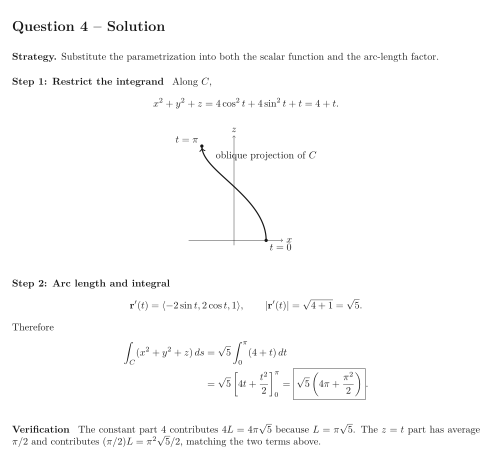
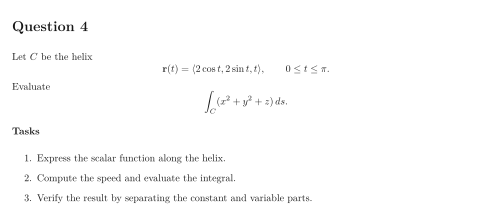
See the diagram in the original worksheet below.

Step 2: Arc length and integral 𝒓′(t)=⟨−2sin⁡t,2cos⁡t,1⟩,|𝒓′(t)|=4+1=5.\mathbf r'(t)=\langle-2\sin t,2\cos t,1\rangle, \qquad |\mathbf r'(t)|=\sqrt{4+1}=\sqrt 5. Therefore ∫C(x2+y2+z)ds=5∫0π(4+t)dt=5[4t+t22]0π=5(4π+π22).\begin{align*} \int_C(x^2+y^2+z)\,ds &=\sqrt 5\int_0^\pi(4+t)\,dt\\ &=\sqrt 5\left[4t+\frac{t^2}{2}\right]_0^\pi =\boxed{\sqrt 5\left(4\pi+\frac{\pi^2}{2}\right)}. \end{align*}

Verification The constant part 44 contributes 4L=4π54L=4\pi\sqrt 5 because L=π5L=\pi\sqrt 5. The z=tz=t part has average π/2\pi/2 and contributes (π/2)L=π25/2(\pi/2)L=\pi^2\sqrt 5/2, matching the two terms above.

Original worksheet page 2: question and worked solution for 5-2-004

Original worksheet layout. Use Enlarge or open the PDF for a closer view.