Line Integrals - Part I — Question 1

PDF ↗

Question 1

Evaluate the scalar line integral ∫C(x+y)ds,\int_C(x+y)\,ds, where CC is the line segment from (0,0)(0,0) to (3,4)(3,4).

Tasks

  1. Parametrize CC on 0≤t≤10\le t\le 1.

  2. Compute dsds and evaluate the integral.

  3. Verify the constant speed and total length of the segment.
Original worksheet page 1: question and worked solution for 5-2-001
Show solutionHide solution

Question 1 – Solution

Strategy. Use linear interpolation between the endpoints, then replace dsds by |𝒓′(t)|dt|\mathbf r'(t)|\,dt.

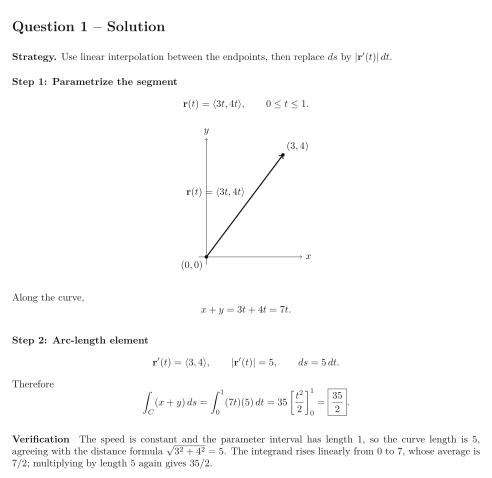
Step 1: Parametrize the segment 𝒓(t)=⟨3t,4t⟩,0≤t≤1.\mathbf r(t)=\langle 3t,4t\rangle,\qquad 0\le t\le 1.

See the diagram in the original worksheet below.

Along the curve, x+y=3t+4t=7t.x+y=3t+4t=7t.

Step 2: Arc-length element 𝒓′(t)=⟨3,4⟩,|𝒓′(t)|=5,ds=5dt.\mathbf r'(t)=\langle 3,4\rangle,\qquad |\mathbf r'(t)|=5,\qquad ds=5\,dt. Therefore ∫C(x+y)ds=∫01(7t)(5)dt=35[t22]01=352.\int_C(x+y)\,ds =\int_0^1(7t)(5)\,dt =35\left[\frac{t^2}{2}\right]_0^1 =\boxed{\frac{35}{2}}.

Verification The speed is constant and the parameter interval has length 11, so the curve length is 55, agreeing with the distance formula 32+42=5\sqrt{3^2+4^2}=5. The integrand rises linearly from 00 to 77, whose average is 7/27/2; multiplying by length 55 again gives 35/235/2.

Original worksheet page 2: question and worked solution for 5-2-001

Original worksheet layout. Use Enlarge or open the PDF for a closer view.