Vector Fields β€” Question 7

PDF β†—

Question 7

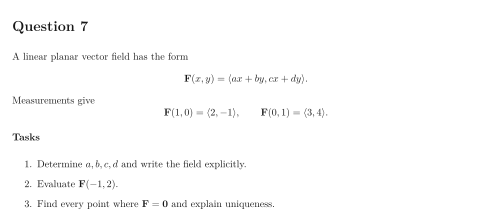
A linear planar vector field has the form 𝑭(x,y)=⟨ax+by,cx+dy⟩.\mathbf F(x,y)= \langle ax+by,cx+dy\rangle. Measurements give 𝑭(1,0)=⟨2,βˆ’1⟩,𝑭(0,1)=⟨3,4⟩.\mathbf F(1,0)=\langle 2,-1\rangle,\qquad \mathbf F(0,1)=\langle 3,4\rangle.

Tasks

  1. Determine a,b,c,da,b,c,d and write the field explicitly.

  2. Evaluate 𝑭(βˆ’1,2)\mathbf F(-1,2).

  3. Find every point where 𝑭=𝟎\mathbf F=\mathbf 0 and explain uniqueness.

Original worksheet page 1: question and worked solution for 5-1-007
Show solutionHide solution

Question 7 – Solution

Strategy. The values on the coordinate basis vectors are exactly the columns of the matrix representing a linear field.

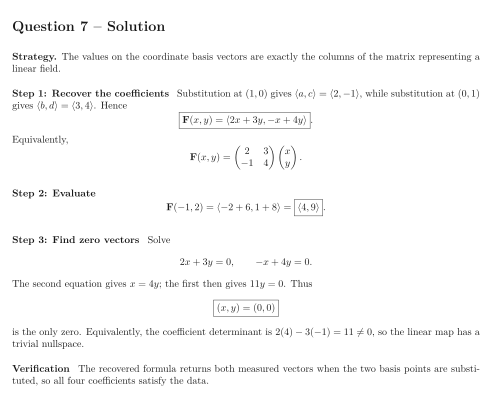
Step 1: Recover the coefficients Substitution at (1,0)(1,0) gives ⟨a,c⟩=⟨2,βˆ’1⟩\langle a,c\rangle=\langle 2,-1\rangle, while substitution at (0,1)(0,1) gives ⟨b,d⟩=⟨3,4⟩\langle b,d\rangle=\langle 3,4\rangle. Hence 𝑭(x,y)=⟨2x+3y,βˆ’x+4y⟩.\boxed{\mathbf F(x,y)=\langle 2x+3y,-x+4y\rangle}. Equivalently, 𝑭(x,y)=(23βˆ’14)(xy).\mathbf F(x,y)= \begin{pmatrix}2&3\\-1&4\end{pmatrix} \begin{pmatrix}x\\y\end{pmatrix}.

Step 2: Evaluate 𝑭(βˆ’1,2)=βŸ¨βˆ’2+6,1+8⟩=⟨4,9⟩.\mathbf F(-1,2) =\langle-2+6,1+8\rangle =\boxed{\langle 4,9\rangle}.

Step 3: Find zero vectors Solve 2x+3y=0,βˆ’x+4y=0.2x+3y=0,\qquad -x+4y=0. The second equation gives x=4yx=4y; the first then gives 11y=011y=0. Thus (x,y)=(0,0)\boxed{(x,y)=(0,0)} is the only zero. Equivalently, the coefficient determinant is 2(4)βˆ’3(βˆ’1)=11β‰ 02(4)-3(-1)=11\ne 0, so the linear map has a trivial nullspace.

Verification The recovered formula returns both measured vectors when the two basis points are substituted, so all four coefficients satisfy the data.
Original worksheet page 2: question and worked solution for 5-1-007

Original worksheet layout. Use Enlarge or open the PDF for a closer view.