Surface Area — Question 10

PDF ↗

Question 10

Let ff be continuously differentiable on a region DD of area 1212, and suppose 1≤|∇f(x,y)|≤2throughout D.1\le|\nabla f(x,y)|\le 2\qquad\text{throughout }D. Let SS be the area of the graph z=f(x,y)z=f(x,y) above DD.

Tasks

  1. Derive the sharpest bounds guaranteed for SS.

  2. Prove the bounds from the surface-area integral.

  3. Show that both endpoints can occur.

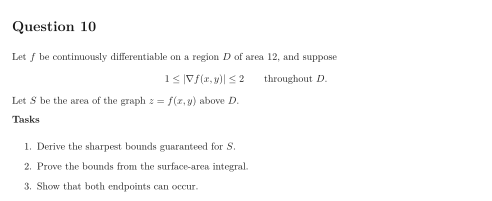
Original worksheet page 1: question and worked solution for 4-9-010
Show solutionHide solution

Question 10 – Solution

Strategy. Apply the monotonicity of 1+t2\sqrt{1+t^2} to the pointwise gradient bounds, then integrate.

Step 1: Pointwise comparison From 1≤|∇f|≤21\le|\nabla f|\le 2, 2=1+12≤1+|∇f|2≤1+22=5.\sqrt 2=\sqrt{1+1^2} \le\sqrt{1+|\nabla f|^2} \le\sqrt{1+2^2}=\sqrt 5.

Step 2: Integrate The graph area is S=∬D1+|∇f|2dA.S=\iint_D\sqrt{1+|\nabla f|^2}\,dA. Integrating the pointwise inequalities and using area⁡(D)=12\operatorname{area}(D)=12 yields 122≤S≤125.\boxed{12\sqrt 2\le S\le 12\sqrt 5}.

Step 3: Sharpness The lower endpoint occurs for any plane with constant gradient magnitude 11, for example f(x,y)=xf(x,y)=x. The upper endpoint occurs for a plane with constant gradient magnitude 22, for example f(x,y)=2xf(x,y)=2x. Indeed, Sf=x=121+1=122,Sf=2x=121+4=125.S_{\;f=x}=12\sqrt{1+1}=12\sqrt 2,\qquad S_{\;f=2x}=12\sqrt{1+4}=12\sqrt 5. Therefore no narrower interval can be guaranteed from the supplied data.
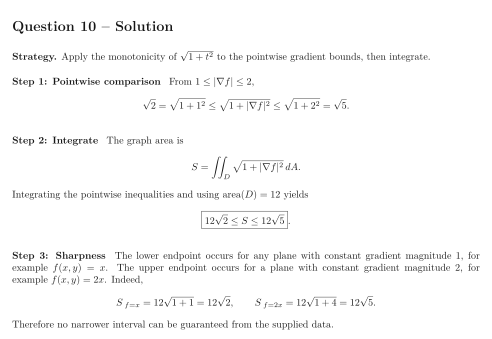
Original worksheet page 2: question and worked solution for 4-9-010

Original worksheet layout. Use Enlarge or open the PDF for a closer view.