Surface Area — Question 7

PDF ↗

Question 7

Find the area of the surface z=xyz=xy above the quarter-disk x2+y2≤1x^2+y^2\le 1, x≥0x\ge 0, y≥0y\ge 0.

Tasks

  1. Show that the surface-area factor is radial even though z=xyz=xy is not.

  2. Evaluate the polar integral.

  3. Verify the angular and radial bounds.
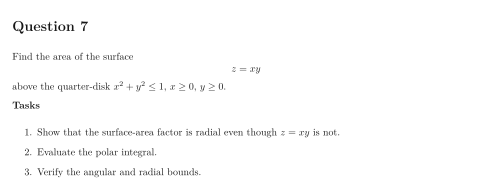
Original worksheet page 1: question and worked solution for 4-9-007
Show solutionHide solution

Question 7 – Solution

Strategy. Differentiate first: the two gradient components exchange xx and yy, so their squares combine to r2r^2.

Step 1: Gradient and projection fx=y,fy=x,1+fx2+fy2=1+x2+y2=1+r2.f_x=y,\qquad f_y=x,\qquad \sqrt{1+f_x^2+f_y^2}=\sqrt{1+x^2+y^2}=\sqrt{1+r^2}.

See the diagram in the original worksheet below.

The quarter-disk has 0≤θ≤π/20\le\theta\le\pi/2 and 0≤r≤10\le r\le 1.

Step 2: Evaluate S=∫0π/2∫011+r2rdrdθ=π2[(1+r2)3/23]01=π6(22−1).\begin{align*} S&=\int_0^{\pi/2}\int_0^1\sqrt{1+r^2}\,r\,dr\,d\theta\\ &=\frac{\pi}{2}\left[\frac{(1+r^2)^{3/2}}{3}\right]_0^1 =\boxed{\frac{\pi}{6}(2\sqrt 2-1)}. \end{align*}

Verification The angular width is one quarter of a full turn. The factor ranges from 11 to 2\sqrt 2, so the result must lie between the projection area π/4\pi/4 and 2π/4\sqrt 2\,\pi/4; it does.

Original worksheet page 2: question and worked solution for 4-9-007

Original worksheet layout. Use Enlarge or open the PDF for a closer view.