Question 10
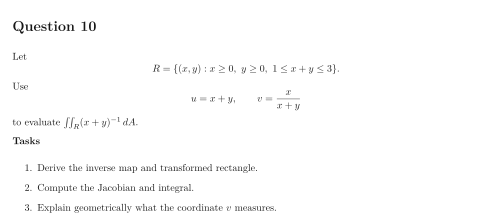
Let Use to evaluate .
Tasks
Derive the inverse map and transformed rectangle.
Compute the Jacobian and integral.
Explain geometrically what the coordinate measures.
Show solutionHide solution
Question 10 – Solution
Strategy. Use total distance along the coordinate-sum direction and the fraction allocated to .
Step 1: Inverse and geometry Since , Nonnegativity gives , while the two diagonal boundaries give .
See the diagram in the original worksheet below.
Step 2: Jacobian Hence the integrand cancels the area scale:
Step 3: Interpretation and check On a segment , the quantity is the fraction of the total coordinate sum assigned to ; it runs once from the -axis to the -axis. Thus the inverse is one-to-one in the interior, and confirms the absolute Jacobian used above.
