Change of Variables — Question 5

PDF ↗

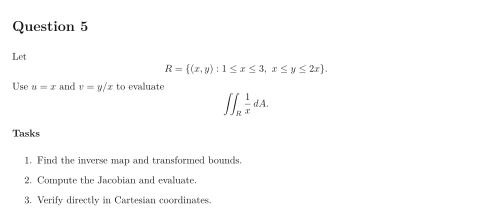
Question 5

Let R={(x,y):1≤x≤3,x≤y≤2x}.R=\{(x,y):1\le x\le 3,\ x\le y\le 2x\}. Use u=xu=x and v=y/xv=y/x to evaluate ∬R1xdA.\iint_R\frac 1x\,dA.

Tasks

  1. Find the inverse map and transformed bounds.

  2. Compute the Jacobian and evaluate.

  3. Verify directly in Cartesian coordinates.
Original worksheet page 1: question and worked solution for 4-8-005
Show solutionHide solution

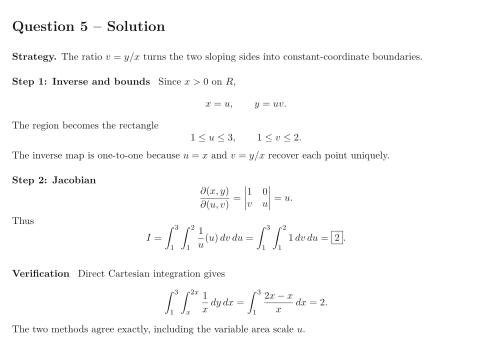
Question 5 – Solution

Strategy. The ratio v=y/xv=y/x turns the two sloping sides into constant-coordinate boundaries.

Step 1: Inverse and bounds Since x>0x>0 on RR, x=u,y=uv.x=u,\qquad y=uv. The region becomes the rectangle 1≤u≤3,1≤v≤2.1\le u\le 3,\qquad 1\le v\le 2. The inverse map is one-to-one because u=xu=x and v=y/xv=y/x recover each point uniquely.

Step 2: Jacobian ∂(x,y)∂(u,v)=∣10vu∣=u.\frac{\partial(x,y)}{\partial(u,v)} =\begin{vmatrix}1&0\\v&u\end{vmatrix}=u. Thus I=∫13∫121u(u)dvdu=∫13∫121dvdu=2.I=\int_1^3\int_1^2\frac 1u(u)\,dv\,du =\int_1^3\int_1^2 1\,dv\,du=\boxed{2}.

Verification Direct Cartesian integration gives ∫13∫x2x1xdydx=∫132x−xxdx=2.\int_1^3\int_x^{2x}\frac 1x\,dy\,dx =\int_1^3\frac{2x-x}{x}\,dx=2. The two methods agree exactly, including the variable area scale uu.

Original worksheet page 2: question and worked solution for 4-8-005

Original worksheet layout. Use Enlarge or open the PDF for a closer view.