Triple Integrals in Cylindrical Coordinates — Question 3

PDF ↗

Question 3

Let EE lie above the cone z=x2+y2z=\sqrt{x^2+y^2} and below the paraboloid z=2−x2−y2z=2-x^2-y^2.

Tasks

  1. Find the curve where the two surfaces meet.

  2. Set up and evaluate ∭E1dV\iiint_E1\,dV in cylindrical coordinates.

  3. Verify that the vertical bounds are correctly ordered.
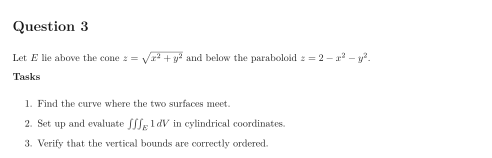
Original worksheet page 1: question and worked solution for 4-6-003
Show solutionHide solution

Question 3 – Solution

Strategy. Convert both surfaces to functions of rr, solve for their positive intersection radius, and integrate top minus bottom.

Step 1: Intersection The surfaces are z=rz=r and z=2−r2z=2-r^2. Their intersection satisfies r=2−r2⇔(r−1)(r+2)=0.r=2-r^2\quad\Longleftrightarrow\quad(r-1)(r+2)=0. Since r≥0r\ge 0, the boundary circle is r=1r=1, z=1z=1.

See the diagram in the original worksheet below.

Step 2: Integral V=∫02π∫01∫r2−r2rdzdrdθ=2π∫01(2−r2−r)rdr=2π(1−14−13)=5π6.\begin{align*} V&=\int_0^{2\pi}\int_0^1\int_r^{2-r^2}r\,dz\,dr\,d\theta\\ &=2\pi\int_0^1(2-r^2-r)r\,dr =2\pi\left(1-\frac 14-\frac 13\right) =\boxed{\frac{5\pi}{6}}. \end{align*}

Verification For 0≤r≤10\le r\le 1, 2−r2−r=(1−r)(r+2)≥02-r^2-r=(1-r)(r+2)\ge 0, so the upper and lower zz-bounds never reverse.

Original worksheet page 2: question and worked solution for 4-6-003

Original worksheet layout. Use Enlarge or open the PDF for a closer view.