Double Integrals in Polar Coordinates — Question 6

PDF ↗

Question 6

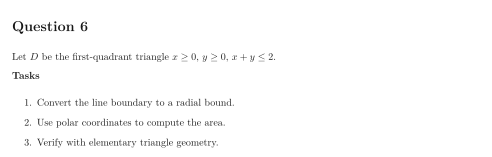
Let DD be the first-quadrant triangle x≥0x\ge 0, y≥0y\ge 0, x+y≤2x+y\le 2.

Tasks

  1. Convert the line boundary to a radial bound.

  2. Use polar coordinates to compute the area.

  3. Verify with elementary triangle geometry.

Original worksheet page 1: question and worked solution for 4-4-006
Show solutionHide solution

Question 6 – Solution

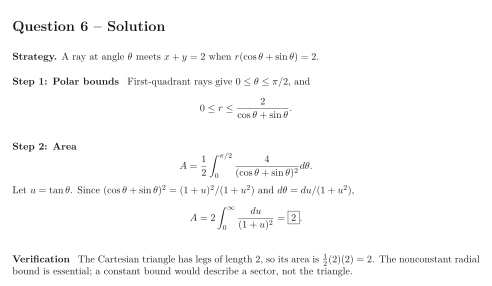
Strategy. A ray at angle θ\theta meets x+y=2x+y=2 when r(cos⁡θ+sin⁡θ)=2r(\cos\theta+\sin\theta)=2.

Step 1: Polar bounds First-quadrant rays give 0≤θ≤π/20\le\theta\le\pi/2, and 0≤r≤2cos⁡θ+sin⁡θ.0\le r\le\frac{2}{\cos\theta+\sin\theta}.

Step 2: Area A=12∫0π/24(cos⁡θ+sin⁡θ)2dθ.A=\frac 12\int_0^{\pi/2}\frac{4}{(\cos\theta+\sin\theta)^2}d\theta. Let u=tan⁡θu=\tan\theta. Since (cos⁡θ+sin⁡θ)2=(1+u)2/(1+u2)(\cos\theta+\sin\theta)^2=(1+u)^2/(1+u^2) and dθ=du/(1+u2)d\theta=du/(1+u^2), A=2∫0∞du(1+u)2=2.A=2\int_0^\infty\frac{du}{(1+u)^2}=\boxed{2}.

Verification The Cartesian triangle has legs of length 22, so its area is 12(2)(2)=2\frac 12(2)(2)=2. The nonconstant radial bound is essential; a constant bound would describe a sector, not the triangle.

Original worksheet page 2: question and worked solution for 4-4-006

Original worksheet layout. Use Enlarge or open the PDF for a closer view.