Double Integrals in Polar Coordinates — Question 1

PDF ↗

Question 1

Let DD be the disk x2+y2≤4x^2+y^2\le 4.

Tasks

  1. Convert x2+y2x^2+y^2 and dAdA to polar form.

  2. Set up and evaluate ∬D(x2+y2)dA\iint_D(x^2+y^2)dA.

  3. Explain the Jacobian factor geometrically.

Original worksheet page 1: question and worked solution for 4-4-001
Show solutionHide solution

Question 1 – Solution

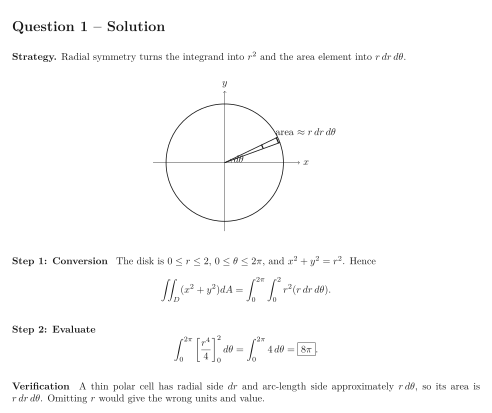
Strategy. Radial symmetry turns the integrand into r2r^2 and the area element into rdrdθr\,dr\,d\theta.

See the diagram in the original worksheet below.

Step 1: Conversion The disk is 0≤r≤20\le r\le 2, 0≤θ≤2π0\le\theta\le 2\pi, and x2+y2=r2x^2+y^2=r^2. Hence ∬D(x2+y2)dA=∫02π∫02r2(rdrdθ).\iint_D(x^2+y^2)dA=\int_0^{2\pi}\int_0^2r^2(r\,dr\,d\theta).

Step 2: Evaluate ∫02π[r44]02dθ=∫02π4dθ=8π.\int_0^{2\pi}\left[\frac{r^4}{4}\right]_0^2d\theta =\int_0^{2\pi}4\,d\theta=\boxed{8\pi}.

Verification A thin polar cell has radial side drdr and arc-length side approximately rdθr\,d\theta, so its area is rdrdθr\,dr\,d\theta. Omitting rr would give the wrong units and value.

Original worksheet page 2: question and worked solution for 4-4-001

Original worksheet layout. Use Enlarge or open the PDF for a closer view.