Double Integrals over General Regions — Question 7

PDF ↗

Question 7

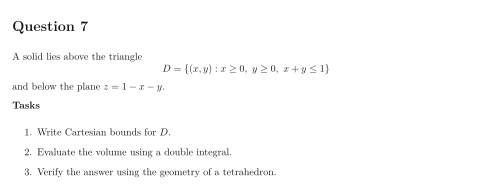
A solid lies above the triangle D={(x,y):x≥0,y≥0,x+y≤1}D=\{(x,y):x\ge 0,\ y\ge 0,\ x+y\le 1\} and below the plane z=1−x−yz=1-x-y.

Tasks

  1. Write Cartesian bounds for DD.

  2. Evaluate the volume using a double integral.

  3. Verify the answer using the geometry of a tetrahedron.
Original worksheet page 1: question and worked solution for 4-3-007
Show solutionHide solution

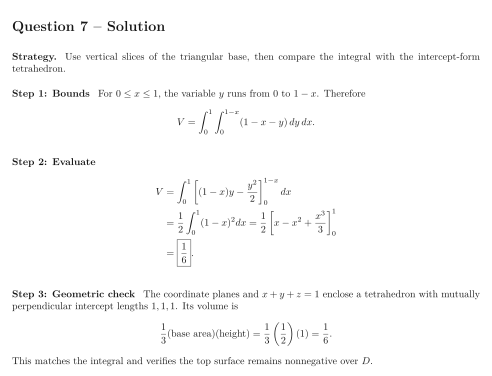
Question 7 – Solution

Strategy. Use vertical slices of the triangular base, then compare the integral with the intercept-form tetrahedron.

Step 1: Bounds For 0≤x≤10\le x\le 1, the variable yy runs from 00 to 1−x1-x. Therefore V=∫01∫01−x(1−x−y)dydx.V=\int_0^1\int_0^{1-x}(1-x-y)\,dy\,dx.

Step 2: Evaluate V=∫01[(1−x)y−y22]01−xdx=12∫01(1−x)2dx=12[x−x2+x33]01=16.\begin{align*} V&=\int_0^1\left[(1-x)y-\frac{y^2}{2}\right]_0^{1-x}dx\\ &=\frac 12\int_0^1(1-x)^2dx =\frac 12\left[x-x^2+\frac{x^3}{3}\right]_0^1\\ &=\boxed{\frac 16}. \end{align*}

Step 3: Geometric check The coordinate planes and x+y+z=1x+y+z=1 enclose a tetrahedron with mutually perpendicular intercept lengths 1,1,11,1,1. Its volume is 13(base area)(height)=13(12)(1)=16.\frac 13(\text{base area})(\text{height}) =\frac 13\left(\frac 12\right)(1)=\frac 16. This matches the integral and verifies the top surface remains nonnegative over DD.

Original worksheet page 2: question and worked solution for 4-3-007

Original worksheet layout. Use Enlarge or open the PDF for a closer view.