Iterated Integrals — Question 6

PDF ↗

Question 6

For a real parameter aa, define I(a)=∫02∫−11(axy2+x2−2y)dydx.I(a)=\int_0^2\int_{-1}^{1}\bigl(axy^2+x^2-2y\bigr)\,dy\,dx.

Tasks

  1. Evaluate I(a)I(a) exactly.

  2. Find the unique value of aa for which the integrand’s average value on the rectangle is 11.

  3. Verify the resulting integral directly from the inner accumulation function.
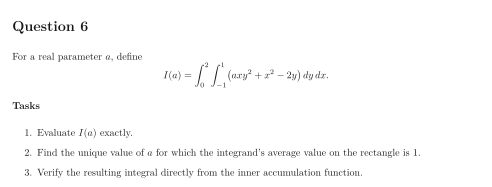
Original worksheet page 1: question and worked solution for 4-2-006
Show solutionHide solution

Question 6 – Solution

Strategy. Use parity in the symmetric yy-interval, retain the parameter symbolically, and convert the prescribed average into a total integral.

Step 1: Inner accumulation Since −2y-2y is odd, ∫−11(axy2+x2−2y)dy=ax[y33]−11+x2[y]−11=2ax3+2x2.\begin{align*} \int_{-1}^{1}(axy^2+x^2-2y)\,dy &=ax\left[\frac{y^3}{3}\right]_{-1}^{1}+x^2[y]_{-1}^{1}\\ &=\frac{2ax}{3}+2x^2. \end{align*} Thus I(a)=∫02(2ax3+2x2)dx=4a3+163.I(a)=\int_0^2\left(\frac{2ax}{3}+2x^2\right)dx =\frac{4a}{3}+\frac{16}{3}.

Step 2: Prescribed average The rectangle’s area is 2⋅2=42\cdot 2=4. Average value 11 therefore requires I(a)=4I(a)=4: 4a+163=4⇒a=−1.\frac{4a+16}{3}=4 \quad\Longrightarrow\quad \boxed{a=-1}.

Step 3: Direct verification With a=−1a=-1, the inner accumulation is −2x3+2x2.-\frac{2x}{3}+2x^2. Consequently, ∫02(−2x3+2x2)dx=[−x23+2x33]02=−43+163=4.\int_0^2\left(-\frac{2x}{3}+2x^2\right)dx =\left[-\frac{x^2}{3}+\frac{2x^3}{3}\right]_0^2 =-\frac 43+\frac{16}{3}=4. Dividing by area 44 returns the required average 11.

Original worksheet page 2: question and worked solution for 4-2-006

Original worksheet layout. Use Enlarge or open the PDF for a closer view.