Area and Volume Revisited — Question 10

PDF ↗

Question 10

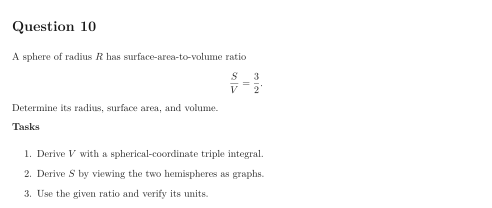
A sphere of radius RR has surface-area-to-volume ratio SV=32.\frac{S}{V}=\frac 32. Determine its radius, surface area, and volume.

Tasks

  1. Derive VV with a spherical-coordinate triple integral.

  2. Derive SS by viewing the two hemispheres as graphs.

  3. Use the given ratio and verify its units.
Original worksheet page 1: question and worked solution for 4-10-010
Show solutionHide solution

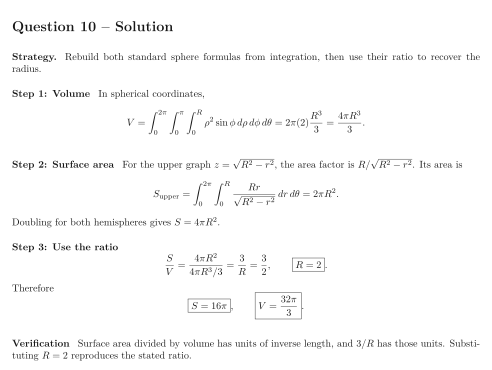
Question 10 – Solution

Strategy. Rebuild both standard sphere formulas from integration, then use their ratio to recover the radius.

Step 1: Volume In spherical coordinates, V=∫02π∫0π∫0Rρ2sin⁡ϕdρdϕdθ=2π(2)R33=4πR33.\begin{align*} V&=\int_0^{2\pi}\int_0^\pi\int_0^R \rho^2\sin\phi\,d\rho\,d\phi\,d\theta =2\pi(2)\frac{R^3}{3}=\frac{4\pi R^3}{3}. \end{align*}

Step 2: Surface area For the upper graph z=R2−r2z=\sqrt{R^2-r^2}, the area factor is R/R2−r2R/\sqrt{R^2-r^2}. Its area is Supper=∫02π∫0RRrR2−r2drdθ=2πR2.\begin{align*} S_{\mathrm{upper}}&=\int_0^{2\pi}\int_0^R \frac{Rr}{\sqrt{R^2-r^2}}\,dr\,d\theta=2\pi R^2. \end{align*} Doubling for both hemispheres gives S=4πR2S=4\pi R^2.

Step 3: Use the ratio SV=4πR24πR3/3=3R=32,R=2.\frac{S}{V}=\frac{4\pi R^2}{4\pi R^3/3}=\frac 3R=\frac 32, \qquad \boxed{R=2}. Therefore S=16π,V=32π3.\boxed{S=16\pi},\qquad \boxed{V=\frac{32\pi}{3}}.

Verification Surface area divided by volume has units of inverse length, and 3/R3/R has those units. Substituting R=2R=2 reproduces the stated ratio.

Original worksheet page 2: question and worked solution for 4-10-010

Original worksheet layout. Use Enlarge or open the PDF for a closer view.