Question 4
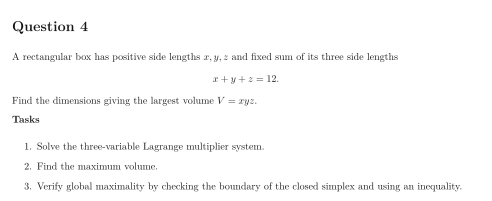
A rectangular box has positive side lengths and fixed sum of its three side lengths Find the dimensions giving the largest volume .
Tasks
Solve the three-variable Lagrange multiplier system.
Find the maximum volume.
Verify global maximality by checking the boundary of the closed simplex and using an inequality.
Show solutionHide solution
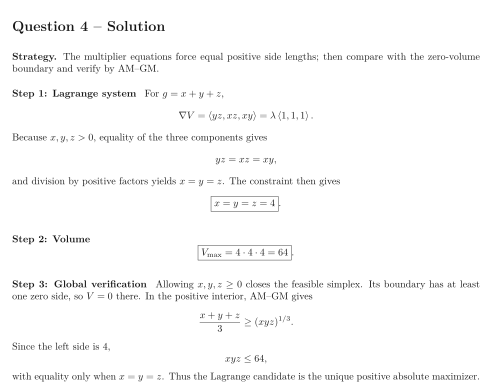
Question 4 – Solution
Strategy. The multiplier equations force equal positive side lengths; then compare with the zero-volume boundary and verify by AM–GM.
Step 1: Lagrange system For , Because , equality of the three components gives and division by positive factors yields . The constraint then gives
Step 2: Volume
Step 3: Global verification Allowing closes the feasible simplex. Its boundary has at least one zero side, so there. In the positive interior, AM–GM gives Since the left side is , with equality only when . Thus the Lagrange candidate is the unique positive absolute maximizer.