Lagrange Multipliers — Question 2

PDF ↗

Question 2

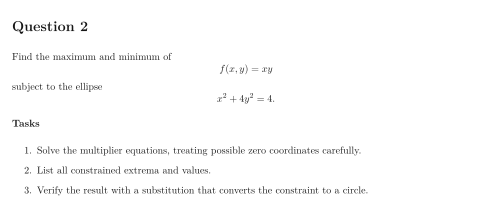
Find the maximum and minimum of f(x,y)=xyf(x,y)=xy subject to the ellipse x2+4y2=4.x^2+4y^2=4.

Tasks

  1. Solve the multiplier equations, treating possible zero coordinates carefully.

  2. List all constrained extrema and values.

  3. Verify the result with a substitution that converts the constraint to a circle.
Original worksheet page 1: question and worked solution for 3-5-002
Show solutionHide solution

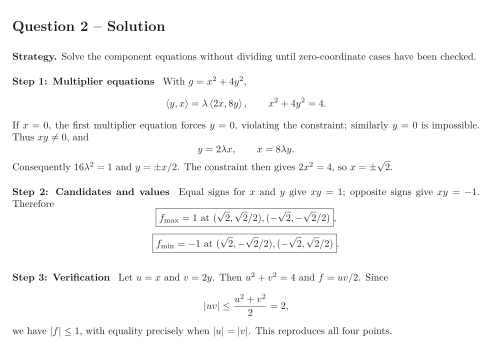
Question 2 – Solution

Strategy. Solve the component equations without dividing until zero-coordinate cases have been checked.

Step 1: Multiplier equations With g=x2+4y2g=x^2+4y^2, ⟨y,x⟩=λ⟨2x,8y⟩,x2+4y2=4.\left\langle y,x\right\rangle=\lambda\left\langle 2x,8y\right\rangle, \qquad x^2+4y^2=4. If x=0x=0, the first multiplier equation forces y=0y=0, violating the constraint; similarly y=0y=0 is impossible. Thus xy≠0xy\ne 0, and y=2λx,x=8λy.y=2\lambda x,\qquad x=8\lambda y. Consequently 16λ2=116\lambda^2=1 and y=±x/2y=\pm x/2. The constraint then gives 2x2=42x^2=4, so x=±2x=\pm\sqrt 2.

Step 2: Candidates and values Equal signs for xx and yy give xy=1xy=1; opposite signs give xy=−1xy=-1. Therefore fmax=1 at (2,2/2),(−2,−2/2),\boxed{f_{\max}=1\text{ at }(\sqrt 2,\sqrt 2/2), (-\sqrt 2,-\sqrt 2/2)}, fmin=−1 at (2,−2/2),(−2,2/2).\boxed{f_{\min}=-1\text{ at }(\sqrt 2,-\sqrt 2/2), (-\sqrt 2,\sqrt 2/2)}.

Step 3: Verification Let u=xu=x and v=2yv=2y. Then u2+v2=4u^2+v^2=4 and f=uv/2f=uv/2. Since |uv|≤u2+v22=2,|uv|\le\frac{u^2+v^2}{2}=2, we have |f|≤1|f|\le 1, with equality precisely when |u|=|v||u|=|v|. This reproduces all four points.

Original worksheet page 2: question and worked solution for 3-5-002

Original worksheet layout. Use Enlarge or open the PDF for a closer view.