Question 10
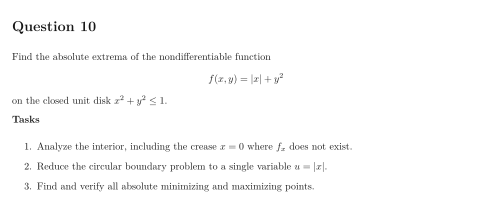
Find the absolute extrema of the nondifferentiable function on the closed unit disk .
Tasks
Analyze the interior, including the crease where does not exist.
Reduce the circular boundary problem to a single variable .
Find and verify all absolute minimizing and maximizing points.
Show solutionHide solution
Question 10 – Solution
Strategy. A complete candidate search must include nondifferentiable points. On the circle, replace by .
Step 1: Interior and crease Where , so there are no differentiable interior critical points. On the crease , Its smallest value is at the origin. Since and everywhere,
See the diagram in the original worksheet below.
Step 2: Circular boundary Let . On , Thus the largest boundary value is , attained when . Then so .
Step 3: Final comparison For a fixed , increasing increases , so an absolute maximum must lie on the circle; the boundary calculation is therefore decisive. Hence where the two signs are independent, giving four points. Direct substitution returns at each.
